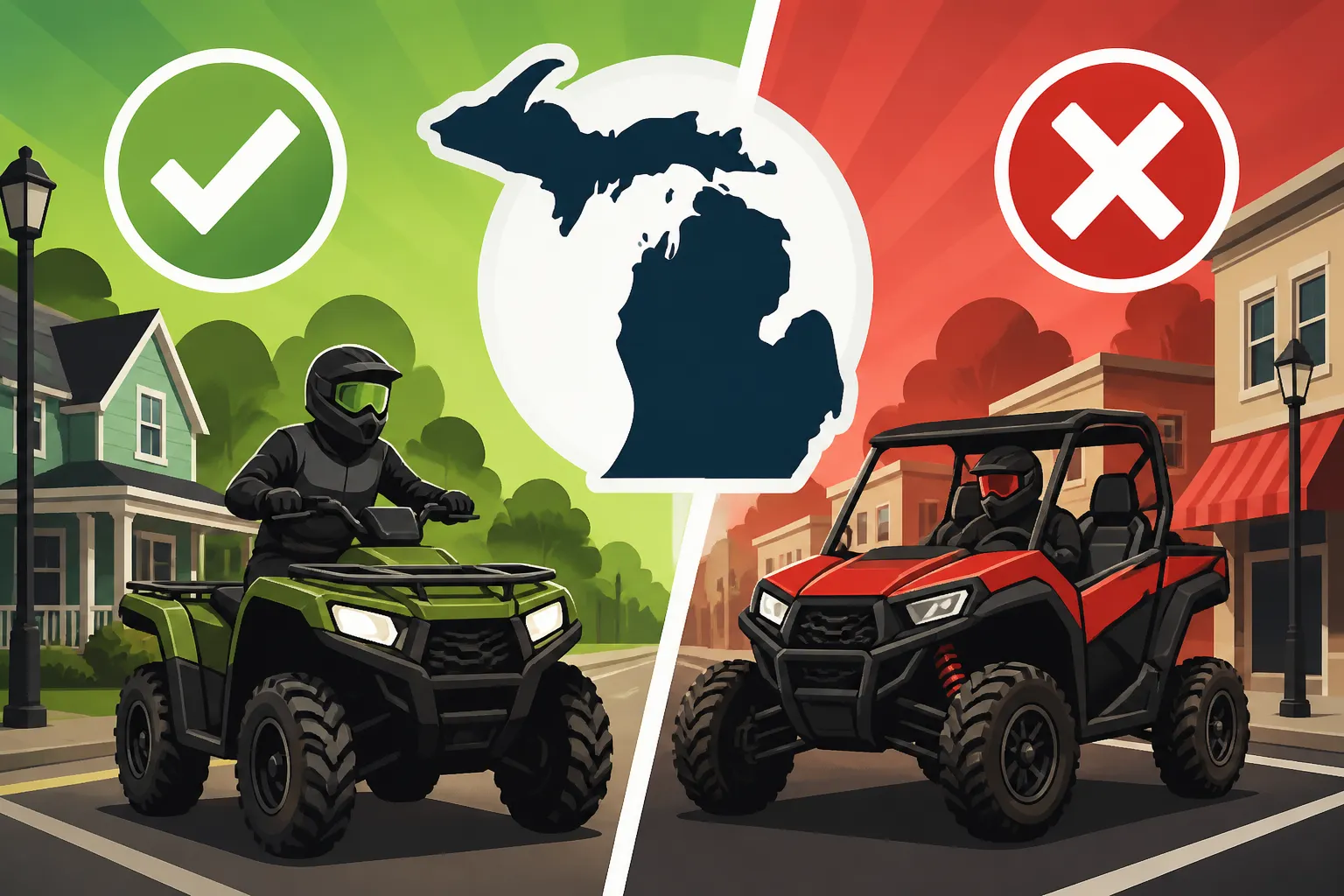
Michigan ORV Rules in Village Limits
Oh, the age-old question that keeps many Michigan ORV enthusiasts scratching their heads: "Can I actually ride my ATV or UTV through town?" It's a common frustration, especially when your favorite trail connects right through a charming village, or you just need to grab gas. The truth is, navigating Michigan's ORV rules within village limits can feel like trying to ride a quad through a swamp – murky and full of hidden obstacles. This guide is here to clear up that mud, explaining exactly what you need to know about where and how you might be able to operate your ORV in Michigan's towns and villages.
The General Rule: Why Villages Are Tricky for ORVs
You've got your machine, your permits, and your helmet, ready to hit the trails or cruise down a county road that's open to ORVs. Then you hit a village limit sign, and suddenly, everything feels different. This isn't just in your head; villages often operate under different rules than the open county roads or state trails you might be used to. It's a key source of confusion for many riders, and honestly, it can be a real headache trying to figure it out on the fly.
The "Local Control" Factor
The biggest reason villages are tricky is something called "local control." While the Michigan Legislature sets a general framework for ORV use across the state, it also gives individual townships, villages, and cities the power to create their own ordinances regarding ORV operation on their local roads. This means that what's perfectly legal in one township might be strictly prohibited just a few miles down the road once you cross into a village's jurisdiction. It's not like the statewide trail system where the rules are generally consistent. Instead, you're dealing with a patchwork of local decisions, each tailored to that community's specific needs or concerns. This can be incredibly frustrating for riders who just want consistent rules to follow.
Default State Law vs. Local Ordinances
When it comes to ORVs, Michigan's state law generally allows for county roads to be opened to ORVs unless a county board of commissioners votes to restrict them. However, for villages and cities, the default is often more restrictive. They usually have to act to open their roads to ORVs, rather than having them open by default. This distinction is crucial. It means you can't assume that just because a county road leading up to a village is open, the village's streets will be too. Each village must affirmatively pass an ordinance to permit ORV operation on some or all of its public roads. Without such an ordinance, riding your ORV on a village street is likely against the law, regardless of state law on county roads. It’s a bit like having a green light on a main highway, only to find a stop sign at every side street once you enter a neighborhood.
How Villages Can Open Their Streets to ORVs
So, if the default is often "no," how do ORVs end up on village streets at all? It's not a mystery, but it does involve a specific process. Understanding this process can help you appreciate why some villages are ORV-friendly and others are not, and why those rules can change over time. It’s also why you often see petitions or community meetings when riders want to open up more access.
The Ordinance Process
For a Michigan village to open its public streets to ORV use, its local governing body – usually the village council – must formally adopt an ordinance. This isn't a quick decision; it typically involves several steps:
- Public Input: Often, residents or ORV enthusiasts will approach the council to request opening roads. There might be public hearings or workshops where citizens can voice their opinions, both for and against the proposal.
- Drafting the Ordinance: If there's enough interest, the village attorney or planner will draft an ordinance. This document outlines exactly which roads (or sections of roads) will be open, what hours, what safety requirements beyond state law, and any other specific conditions. It's not a blanket opening; it's usually very specific.
- Council Votes: The proposed ordinance goes through readings and eventually a vote by the village council. If it passes, it becomes local law.
- Signage: Crucially, if roads are opened, the village is responsible for posting appropriate signage to inform riders where they can and cannot ride. This is often the most visible indicator for you as a rider.
This process ensures that local concerns about noise, safety, and traffic are addressed, but it also means that advocacy from local ORV groups and residents is often key to getting these ordinances passed. For riders, it means the rules are very much a local affair.
Common Restrictions You'll Encounter
Even when a village does open its roads to ORVs, it's almost never a free-for-all. Villages typically include specific restrictions within their ordinances to manage ORV traffic and address local concerns. These are not suggestions; they are enforceable laws that you must follow if you choose to ride in that area.
- Speed Limits: Expect speed limits to be strictly enforced and often lower than on county roads, sometimes as low as 15 or 20 mph, even if the posted limit for cars is higher. This is often to reduce noise and enhance safety for pedestrians and other vehicles.
- Designated Roads Only: Ordinances usually specify exactly which roads are open to ORVs. You might find that only certain through-streets or collector roads are accessible, while residential side streets remain closed. This prevents ORV traffic from impacting quiet neighborhoods. Always look for signage, as venturing onto an unmarked road could result in a ticket.
- Hours of Operation: Many villages restrict ORV use to certain hours, often daylight hours, to mitigate noise complaints from residents. Riding past sunset or before sunrise might be prohibited, even if the road is otherwise open during the day.
- Additional Equipment Requirements: While Michigan state law has minimum equipment requirements, a village ordinance might impose additional ones. For example, some might require specific lighting, mirrors (beyond the standard single mirror for ORVs), or even a horn, especially if the ORV is intended to operate closer to typical street traffic. Checking resources like SuperATV for street-legal conversion kits can be helpful to ensure your machine meets any extra requirements a village might have. You'll want to review the local ordinance carefully to see if your rig needs an upgrade.
These restrictions are put in place to integrate ORVs into the community in a way that minimizes disruption and maximizes safety for everyone. As a rider, your responsibility is to know and abide by these specific local rules.
Navigating Village Limits: What to Do Before You Ride
The key to successfully and legally riding your ORV in or through a Michigan village is preparation. You can't just hope for the best or assume the rules are the same everywhere. Taking a few proactive steps can save you from a frustrating encounter with local law enforcement or, worse, a costly ticket. This is where being a responsible rider really pays off.
Checking Local Ordinances
Before you even load your ORV onto the trailer for a trip that might involve village roads, you need to do your homework. Trust me, a little research upfront is much better than getting pulled over by a village police officer.
- Village Website: The absolute best place to start is the official website of the village you plan to visit. Most municipal websites have a "Clerk's Office," "Ordinances," or "Departments" section where you can find their codified ordinances. Search specifically for "ORV," "off-road vehicle," or "all-terrain vehicle" ordinances.
- Contact the Clerk's Office: If you can't find the information online, or if the language in the ordinance is confusing, don't hesitate to call the village clerk's office. They are the official record keepers and can usually point you to the correct document or answer specific questions. Be polite and clear about what you're asking.
- Local Sheriff or Police Department (as a last resort): While the clerk's office is the primary source for ordinances, local law enforcement officers will be enforcing them. You could call the local police department or sheriff's substation, but they might be less equipped to explain the nuances of an ordinance than the clerk's office. This is more for clarification after you've read the ordinance.
Remember that ordinances can change, so even if you've ridden through a particular village before, it's wise to double-check if it's been a while. This due diligence is crucial to avoid issues, especially when you consider [Michigan ORV Title Problems and How to Clear Them] if you were to face impoundment.
Understanding Signage and Markings
Once you're actually riding and approach a village, the posted signage becomes your most immediate guide. Michigan law, and local ordinances, often require specific signs to indicate where ORVs are allowed.
- "ORV Route" Signs: Look for official signs that explicitly designate a road as an "ORV Route." These are typically green and white, or blue and white, and clearly state that ORVs are permitted. If you don't see these signs, proceed with caution, or assume the road is not open unless you've confirmed it through an ordinance.
- Speed Limit and Hour Signs: If an ORV route has specific speed limits different from regular vehicle traffic, or restricted hours, there should be supplemental signage indicating this. Pay close attention to these, as they are often unique to ORV operation.
- Road Markings: While less common for ORV-specific rules, sometimes roads might have painted markers. Always adhere to any road markings that indicate shared use or specific lanes.
The absence of signage is just as important as the presence of it. If there are no "ORV Route" signs, you cannot assume ORV access simply because there's a dirt road or because the connecting county road was open. Always err on the side of caution. If you're unsure, it's always better to find an alternative route than to risk a citation. You'll also want to keep all your [Michigan ORV Paperwork During a DNR Stop] in order, regardless of local ordinances.
Essential Equipment Beyond State Law
Michigan's state law outlines the basic equipment required for ORVs, like headlights, taillights, and brakes. However, local village ordinances can — and often do — require additional equipment, especially if they are trying to integrate ORVs more closely with traditional vehicle traffic.
- Mirrors: While state law might only require one rear-view mirror for ORVs, a village ordinance might mandate two, particularly for UTVs, to enhance visibility in more congested areas. Companies like SuperATV offer a range of aftermarket mirrors that can help you meet these expanded requirements.
- Turn Signals and Horns: For ORVs operating on roads, especially where they share space with cars, some villages may require turn signals and an audible warning device (horn). These are not always standard on every ORV, so you might need to install an aftermarket kit. This directly relates to the broader push toward making your ORV a "street-legal" machine, an option many riders consider.
- Safety Glass Windshields: If a village allows ORVs on roads where higher speeds or more conventional traffic is present, they might require a windshield made of safety glass rather than polycarbonate, which is commonly found on many UTVs. This is a significant upgrade and cost consideration.
- Tires: Some ordinances might specify DOT-approved tires for ORVs on paved village roads, to ensure they can handle the different traction and wear characteristics of asphalt.
Before embarking on your journey, review the local ordinance for any specific equipment requirements. Installing aftermarket accessories to meet these local rules is a smart investment, not only for compliance but also for your own safety and the safety of others on shared roads. Remember, a ticket for improper equipment can be just as costly as one for being on a prohibited road. For a deeper dive, check out [Michigan Street-Legal UTV Inspection at the Secretary of State].
Common Scenarios and Misconceptions
Riders often have specific situations in mind when they think about riding through a village. It's not always about joyriding; sometimes, it's about practical access. Let's tackle some common questions and clear up some misconceptions that often lead to trouble.
Just Passing Through: Can You Cross a Village?
This is perhaps one of the most common reasons riders want to use village streets: to connect from one trail segment or open county road to another. It's frustrating to have to load up your ORV on a trailer just to get around a two-block stretch of village road.
- It Depends Entirely on the Ordinance: The ability to "just pass through" hinges entirely on whether the village has an ordinance opening its roads, and specifically if it designates through-routes for ORVs. Many villages, when opening their roads, will identify specific routes that allow ORVs to pass from one side of town to the other without having to get off the machine.
- No General Right to Cross: There is no statewide "right to cross" through a village on an ORV if the village has not passed an ordinance allowing it. Even if the village is small and the roads are quiet, you cannot assume this access. Without an ordinance, that quick pass-through could land you a ticket.
- Alternative Routes: If a village does not permit ORV passage, you are legally required to find an alternative. This usually means trailering your ORV around the village limits or finding a designated bypass route. Planning your ride in advance and consulting maps that show ORV-legal routes is critical. Consider resources like the DNR's maps or apps like onX Offroad.
Always confirm the specific village's rules before attempting a "pass-through." Don't assume that because other vehicles can pass through, your ORV can too.
Riding to a Gas Station or Business
Another frequent question: "Can I ride my ORV to the gas station or local diner in town?" Again, this depends heavily on local ordinances. Many villages that allow ORV use do so with specific exceptions or conditions for essential services.
- Designated Access: Some ordinances will specifically allow ORVs on certain roads to access gas stations, restaurants, or other businesses within village limits. These might be limited to specific "service routes" or direct paths to the business from an open ORV road.
- Direct Route Rule: If permitted, you'll often find a "direct route" clause. This means you must take the most direct path from the ORV-legal road to the business and back, without cruising around or deviating onto other streets. It's not an invitation to joyride through the village square.
- Parking Restrictions: Even if you can ride to a business, pay attention to parking. You may only be allowed to park in designated areas, not just anywhere a car might park. Be mindful of space and not blocking other traffic or pedestrian access.
If you plan to use village roads for amenities, always verify that the specific roads leading to your destination are part of an approved ORV route and that your purpose falls within the ordinance's allowances. Remember, the rules are often about practical access, not general recreational riding within the village itself. You'll also want to make sure your machine has its [Michigan ORV License and Trail Permit Explained] properly affixed and up to date, even for these short trips.
Private Property Within Village Limits
What about riding on your own land, or a friend's land, if that property is located within village limits? This brings up a different set of considerations.
- Your Own Property: Generally, Michigan ORV laws apply to public land and roads. On private property that you own, you typically have more latitude. However, even on your own land within village limits, you are still subject to local noise ordinances and nuisance laws. You can't just rev your engine all night without consequence.
- Accessing Private Property: The challenge often comes with accessing your private property. If your land is entirely within village limits, and the village roads leading to it are not open to ORVs, you cannot legally ride your ORV from a public road to your private property. You would need to trailer it. This is a common point of contention and frustration for landowners who own ORVs.
- Neighbor Complaints: Even if you're riding legally on your private property, be considerate of your neighbors. Excessive noise or dust can lead to complaints to the village, which might then prompt enforcement of nuisance ordinances, even if specific ORV ordinances aren't violated. Being a good neighbor helps maintain a positive image for ORV riders.
It’s a nuanced situation: while you generally have rights on your own land, those rights don't extend to using public roads to get there if those roads are closed to ORVs. Always be aware of the [Michigan Trespass Rules for ORV Riders] to avoid unintended violations.
Here's a quick comparison of general ORV rules you might encounter:
| Feature | Typical State ORV Road Rule (County Roads) | Typical Village ORV Ordinance (When Roads are Open) |
|---|---|---|
| Default Access | Open by default unless restricted by county | Closed by default unless opened by ordinance |
| Speed Limit | Often 25 mph or lower, or posted speed limit | Often 15-20 mph, strictly enforced |
| Roads Allowed | Most county roads, unless specifically prohibited | Only designated roads, explicitly signed |
| Operating Hours | Generally 24/7 if road is open | Often restricted to daylight hours |
| Equipment | Basic state requirements (headlight, taillight) | May have additional requirements (extra mirrors, turn signals, horn, safety glass windshields) |
| Pass Through | Generally allowed if roads are open | Only if designated routes exist and are signed |
| Access to Businesses | Generally allowed if roads are open | Only if designated routes and access points exist |
This table highlights why it's so critical to check specific local rules. Each village is truly its own entity when it comes to ORV access.
Ultimately, riding your ORV through a Michigan village means trading the freedom of the trail for the responsibility of being a good, law-ababiding citizen in a shared community space. It's not impossible, but it requires research, attention to signage, and adherence to local regulations. Always prioritize safety and respect for local residents, and you'll ensure that ORVs remain a welcome sight in Michigan's charming villages, rather than a point of contention. The more informed and respectful riders are, the better the chances that these local access points will remain open for everyone.
Disclaimer
This article is for general informational purposes only and does not constitute professional advice. Laws, prices and regulations vary by location and change over time. Consult a qualified professional for guidance on your specific situation.