Youth ATV Rules at Michigan Scramble Areas
A scramble-area ride can look like an easy family outing, but Michigan’s youth rules depend on the rider’s age, machine and supervision. Before loading the ATV, confirm the young rider is eligible, has the required safety certificate and will be directly supervised. This guide explains the public-land rules, permit distinction and practical checks to make before you arrive.
Who can ride an ATV at a Michigan scramble area
Michigan scramble areas are public riding areas, so the state’s public-land rules for young ORV riders apply. According to the Michigan Department of Natural Resources, a rider under 16 must have a valid ORV safety certificate and remain under the direct visual supervision of an adult. The certificate and adult supervision are separate requirements: having one does not replace the other.
The age limit is stricter for some machines. According to the Michigan Department of Natural Resources, children under 10 cannot operate a four-wheel ATV on public lands, and no one under 16 may operate a three-wheeled ATV. Those limits apply even if a child has completed a safety course. An under-16 rider who is old enough to operate a four-wheel ATV on public land still needs the certificate and adult supervision.
| Rider or machine | What the rule means at a public scramble area |
|---|---|
| Under 10 on a four-wheel ATV | The Michigan Department of Natural Resources prohibits operation on public lands. |
| Under 16 on an ATV | The Michigan Department of Natural Resources requires a valid ORV safety certificate and direct visual supervision by an adult. |
| Under 16 on a three-wheeled ATV | The Michigan Department of Natural Resources prohibits operation on public lands. |
| Non-resident rider aged 12 to 15 | The Michigan Legislature says the rider must present a Michigan-compliant ORV safety certificate or a comparable certificate issued under another state’s or a Canadian province’s authority. |
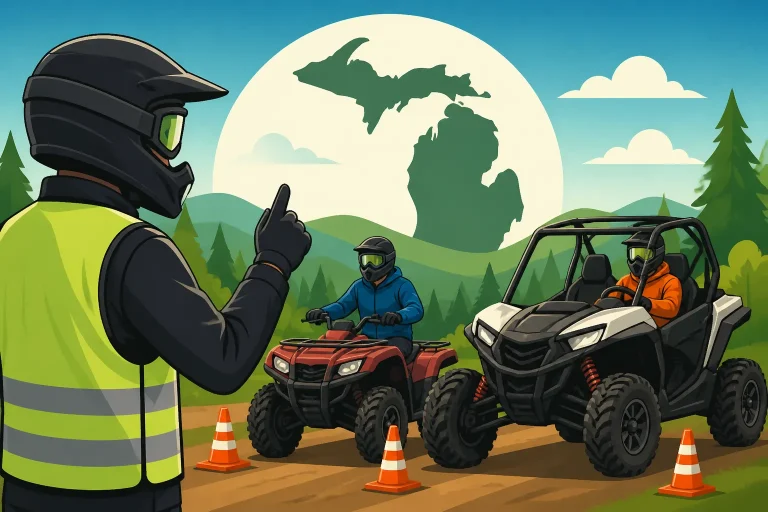
“Direct visual supervision” is not the same as simply being somewhere at the riding area. The adult should be able to see the young rider and supervise the ride as it happens. Plan to stay with the rider, keep the machine within view, and choose terrain and pace that allow you to respond if the rider needs help. If the group spreads out or the terrain blocks your view, the supervision requirement may no longer be met.
The certificate must come from an approved ORV safety course. According to the Department of Natural Resources, anyone under 16 operating an ORV on public lands must complete an approved course and carry the safety certificate. Keep it accessible during the outing rather than assuming a parent’s copy or a photo of an unrelated document will be accepted. For course details, see Michigan ORV Safety Certificate for Riders Under 16 and Michigan Rules for 12- to 15-Year-Old Riders.
Parents should also match the machine to the rider. A child being legally old enough to operate an ATV does not mean every ATV is a suitable fit. Consider whether the rider can reach and use the controls, steer and stop reliably, and handle the machine without relying on an adult to intervene at the last moment. The age-based rules do not set out a one-size-fits-all machine recommendation; choosing an appropriate ATV is a separate safety decision. Youth ATV Size Rules Michigan Parents Should Know offers related guidance.
Certificates, permits and area requirements
A safety certificate and an ORV permit serve different purposes. The certificate shows that a young rider has completed the required safety course; it does not replace the machine’s required license or any permit required for the place where it is being ridden. Likewise, buying an ORV license does not waive the age, supervision or training rules.
According to the Michigan Department of Natural Resources, the annual ORV license costs $26.25, and riding on state-designated ORV trails requires an additional $10.00 trail permit. Together, they cost $36.25, as of October 2026. The trail permit is an additional requirement for those designated trails, rather than a substitute for the base license. Check the specific scramble area’s current rules before setting out, especially if your route includes trails as well as the riding area. See Michigan ORV License and Trail Permit Explained for a closer look at how the permits differ.
The purchase date does not set a fresh twelve-month period. According to the Michigan Department of Natural Resources, annual Michigan ORV licenses and trail permits expire on March 31 of the following year, regardless of when they were bought. Check the expiry date if you are carrying over a permit from an earlier ride.
Area-specific rules can add requirements beyond general youth rules. Silver Lake is one example: according to the Department of Natural Resources, each UTV occupant must wear a seat belt in the Silver Lake ORV Area. That is a location-specific rule, so do not assume that requirements at one scramble area automatically apply at another, or that a rule at another site applies at Silver Lake. Review the current site requirements before loading up; Silver Lake Dune Vehicle Requirements Checklist is useful for that location.
If you are unsure which permit applies, check the official information for the site and the route you intend to ride. Rules may depend on whether you will use a state-designated ORV trail, a scramble area or another public-land riding area. Where to Buy a Michigan ORV License can help with the purchasing step, but confirm the area’s requirements separately.
Gear and machine checks before riding
A certificate and the right permit do not make an ATV ready for a scramble-area ride. Check the machine, protective equipment and rider arrangements before unloading, and make sure each person knows who is supervising whom.
Michigan’s general helmet rule covers ORV operators and passengers. According to the Michigan Legislature, riders generally must wear a Department of Transportation-approved crash helmet and protective eyewear. A limited helmet exception applies to a UTV with an approved roof when occupants wear properly adjusted and fastened seat belts; that exception is not a reason to skip protective equipment on an ATV. If shopping through Amazon or another retailer, verify that a helmet is actually DOT-approved rather than relying on a product description or appearance.
Passengers are another common source of confusion. According to the Michigan Legislature, carrying a passenger on an ORV is illegal unless the vehicle’s design or manufacturing standards specifically provide for passengers. Do not carry a child on an ATV built for a single rider, even for a short trip or at a slow speed. For a UTV designed to carry passengers, follow the applicable restraint requirements and the area’s own rules.
Before riding, check that the machine’s exhaust and spark-control equipment are in working order. According to the Michigan Legislature, an ORV operated on public lands must have a United States Forest Service-approved spark arrester and a muffler in good working order and constant operation. The Michigan Legislature also limits exhaust noise to 94 dB(A) for vehicles manufactured after January 1, 1986, or 99 dB(A) for older vehicles, when tested under the SAE J1287 stationary test procedure. A loud or modified exhaust is not just a nuisance: it can put the machine outside the stated limit.
Night riding has a separate lighting requirement. According to the Michigan Legislature, an ORV must have a lighted headlight and taillight from a half-hour after sunset to a half-hour before sunrise. For a family outing, it is simpler to plan to finish before darkness than to rely on lights that have not been checked.
Conditions matter, too. According to the Michigan Department of Natural Resources, the department can close state trails and facilities because of weather events or wet conditions. Check for closures before leaving and again before riding. State forest roads are generally open year-round unless they are posted otherwise or seasonally closed, according to the Michigan Department of Natural Resources, but that does not mean a scramble area or every trail will be open in poor conditions.
A practical plan for parents and supervising adults
Use a short pre-ride check to catch problems before the young rider is on the machine:
- Confirm eligibility. Check the rider’s age and ATV type against the public-land limits. A child under 10 cannot operate a four-wheel ATV on public lands, and a person under 16 cannot operate a three-wheeled ATV, according to the Michigan Department of Natural Resources.
- Bring the certificate. For an under-16 rider, confirm the approved safety course is complete and the valid ORV safety certificate is available to carry, as required by the Department of Natural Resources.
- Assign an adult supervisor. Make sure one adult can maintain direct visual supervision of the young rider throughout the ride. Agree on how the group will stay together before setting off.
- Check permits and site rules. Confirm the ORV license and any trail permit needed for the route, then review the scramble area’s own requirements. The Department of Natural Resources sets the annual license and designated-trail permit requirements; the site may have additional rules.
- Inspect the machine and gear. Check the helmet, protective eyewear, brakes, controls, lights, muffler and spark arrester. Make sure any passenger is allowed by the machine’s design and is using required restraints.
- Set limits for the ride. Choose terrain the young rider can manage, agree on where the group will stop, and turn back if the adult can no longer maintain visual supervision or conditions become unsuitable.
If the family includes riders with different ages or experience levels, it can help to ride in a smaller group or choose a simpler route. A young rider who is still learning may need more attention than an adult can provide while also navigating a crowded group. Keep the ride within the young person’s ability and leave room to stop when needed.
The central rule is straightforward: at a Michigan public scramble area, an under-16 rider needs both a valid ORV safety certificate and direct visual supervision by an adult, subject to the stricter age limits for four-wheel and three-wheel ATVs. Confirm permits and area-specific requirements before departure, then make sure the machine and protective gear are ready for the conditions.
Sources
- Michigan Department of Natural Resources — ORV FAQs – State of Michigan (checked October 28, 2026)
- Michigan Department of Natural Resources — Purchase permit, learn requirements – State of Michigan (checked October 28, 2026)
- Michigan Legislature — MCL Section 324.81133 (checked October 28, 2026)
Disclaimer
This article is for general informational purposes only and does not constitute professional advice. Laws, prices and regulations vary by location and change over time. Consult a qualified professional for guidance on your specific situation.