Supervising a Young Rider on the Trail
Taking a young rider onto a Michigan trail takes more than choosing a suitable machine. You need to know which age and safety-certificate rules apply, what “direct visual supervision” should look like in practice, and how to keep the ride within the young rider’s ability. This guide covers the essentials for planning a safer public-land ride.
Check the age and certificate rules first
Michigan’s public-land rules set a clear baseline. According to the Department of Natural Resources, anyone under 16 operating an ORV on public lands must have a valid ORV safety certificate and be under the direct visual supervision of an adult. The department also says children under 10 may not operate four-wheel ATVs on public lands. A certificate and an adult nearby do not override that restriction.
For eligible young riders, the certificate is a requirement, not just a recommendation. The Department of Natural Resources says anyone under 16 must complete an approved ORV safety course and carry the certificate while operating an ORV on public lands. Make sure the young rider can produce it during the ride, rather than assuming a photo or a parent’s certificate will be enough. For more on the requirement, see Michigan ORV Safety Certificate for Riders Under 16.
The rule for a young rider and the rule for an adult supervising are separate. An adult needs to be able to supervise the rider directly, while the young operator needs the required certificate. A certificate does not make an underage child eligible to ride a four-wheel ATV where the age restriction applies, and supervision does not replace the certificate requirement.
| Rider situation on public lands | What Michigan requires |
|---|---|
| Under 10 operating a four-wheel ATV | Not permitted on public lands, according to the Department of Natural Resources |
| Under 16 operating an eligible ORV | A valid ORV safety certificate and direct visual supervision by an adult, according to the Department of Natural Resources |
| Age 16 or older operating an ATV | May operate unsupervised on public lands under the age rule described by the Department of Natural Resources |
These rules concern operation on public lands. Don’t assume that a private-property exception, a family’s own rules, or a different type of machine changes what is allowed on a public trail. Check the rules for the land and machine involved before riding.
If you are riding with a visitor from outside Michigan, check certificate recognition rather than assuming a Michigan certificate is the only acceptable one. The Michigan Legislature says non-resident operators aged 12 to 15 must present a Michigan Part 811 certificate or a comparable ORV safety certificate issued under another state’s or a Canadian province’s authority. For a closer look at the age requirements, see Michigan Rules for 12- to 15-Year-Old Riders and Michigan ORV Age Rules at 10, 12 and 16.
What direct visual supervision means in practice
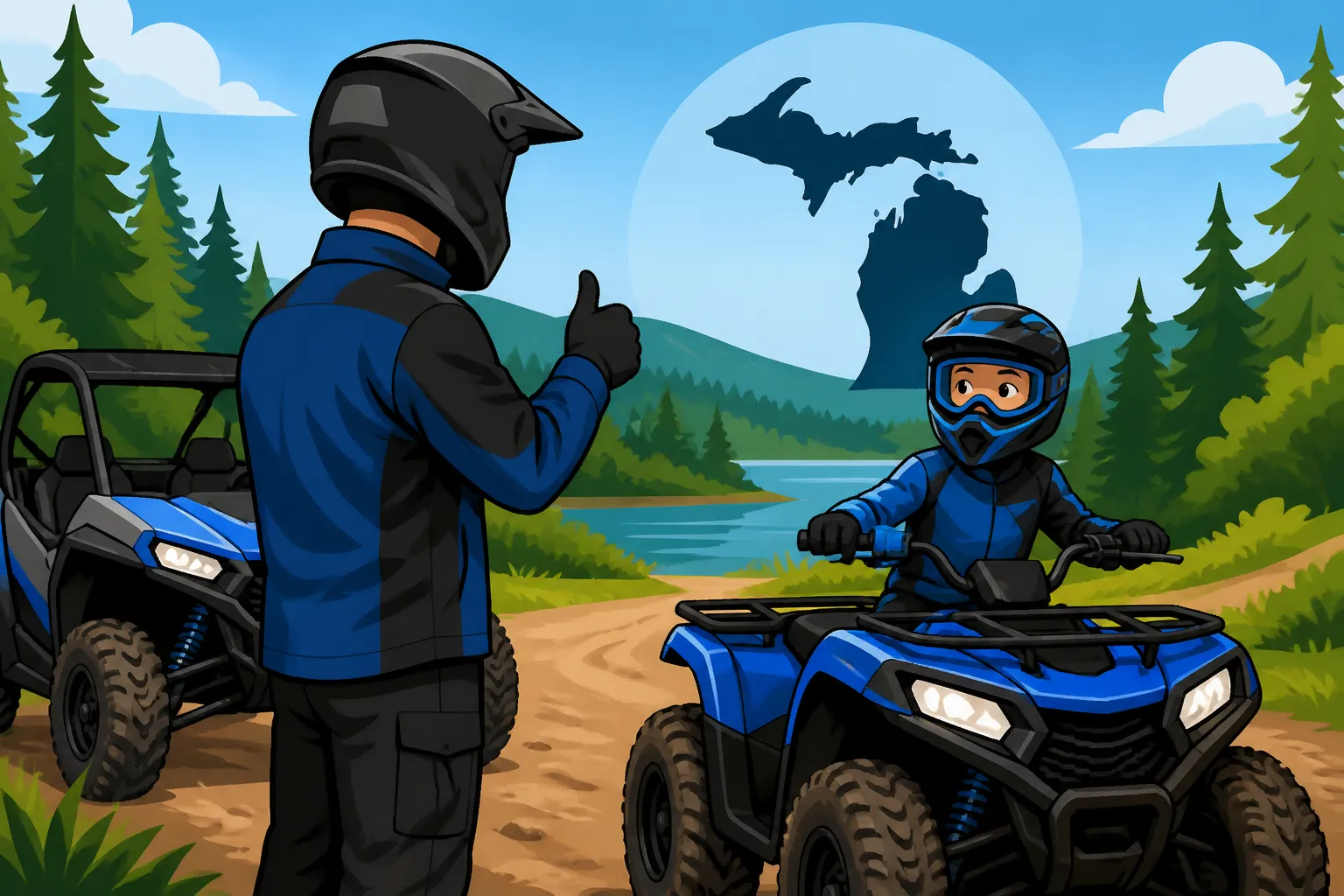
The requirement is legal; the safest way to meet it is practical. Keep the young rider where you can see them, assess what they are doing, and respond immediately if they stop, struggle, or approach a hazard. A phone, radio, or GPS tracker can support communication, but it does not let you visually supervise a rider you cannot see.
Before setting out, agree on simple signals for slowing, stopping, turning around, and reporting a problem. Explain that the young rider should stop in a safe place and wait if they lose sight of the supervising adult. The adult should do the same rather than pressing on in the hope that the group will reconnect farther ahead. For more on the meaning of the supervision requirement, see What Direct Visual Supervision Actually Means.
A group ride can make supervision harder than it looks. If several adults are present, decide who is responsible for watching the young rider. Don’t assume that responsibility has been covered just because another adult is somewhere in the group. On a ride with more than one young operator, plan how the adults will keep each rider in view and avoid separating the group.
Match the ride to the young rider
A young rider may be legally allowed to operate a machine but still not be ready for every route or riding condition. Choose a route that gives the rider room to control speed, stop safely, and respond to changing terrain. A young rider’s comfort and skill matter more than completing a particular loop or keeping up with adults.
Michigan’s public ORV system includes trails and routes with different widths. The Michigan Department of Natural Resources designates motorcycle-only trails maintained at 24 inches, trails maintained at 50 inches, and ORV routes maintained at a minimum of 72 inches.
| Designated ORV type | Width maintained by the Michigan DNR |
|---|---|
| Motorcycle-only trail | 24 inches |
| Trail | 50 inches |
| ORV route | At least 72 inches |
Width is useful when checking whether the route suits the machine, but it does not tell you whether a ride is easy, uncrowded, or appropriate for a beginner. Read signs and maps, check the machine’s permitted route type, and choose terrain with the rider’s current ability in mind. Michigan ORV Trail Widths Explained and Michigan ORV Trail Maps and What the Signs Mean can help with route planning.
Start with a short ride and a conservative pace. Let the young rider get familiar with steering, braking, throttle control, stopping distance, and how the machine responds on the actual surface. Give clear instructions before the ride, then pause regularly to check whether the pace and conditions still feel manageable. If the rider is tiring, anxious, or making repeated mistakes, turn back or stop for the day.
Avoid treating a public route like a training ground for maneuvers the rider has not practiced. A quiet-looking trail can still include loose surfaces, ruts, steep sections, blind turns, or other riders. Stay within the young operator’s demonstrated ability, and be ready to change plans if the trail becomes more difficult than expected.
Confirm the machine and route fit together
Before leaving, confirm that the machine is suitable for the marked route and that the young operator can reach and use its controls comfortably. A rider who cannot confidently steer, brake, or stop should not be sent onto a trail simply because an adult is present. Take time to check basic control in a safe area before entering a public route.
Also check how many people the machine is designed to carry. The Michigan Legislature says carrying a passenger on an ORV is illegal unless the machine’s manufacturing standards or design explicitly provide for transporting passengers. Don’t put a child on a machine built for a single rider, even for a short distance.
If the plan includes a public road designated for ORV use, keep the road rules distinct from the public-land trail rules. The Michigan Legislature says an adult does not need a driver’s license to operate an ATV on a public road designated for ORV use. For a person under 18, the legislature says the rider must either have a valid driver’s license or be under the direct supervision of a parent or guardian while holding an ORV safety certificate. Check the road and local route rules before including a road segment; a trail permit alone does not establish that a road is open to ORVs.
Prepare the rider, machine, and permits
A good pre-ride routine is simple: check required documents, inspect safety equipment, review the route, and make sure the machine is ready. Keep the young rider involved in the checks so they understand what needs attention and how to tell an adult about a problem.
On public lands, the Michigan Legislature generally requires ORV operators and passengers to wear a Department of Transportation-approved crash helmet and protective eyewear. The legislature also describes exceptions in certain conditions, including riding in a UTV equipped with an approved roof and properly fastened safety belts. Don’t assume an exception applies to a particular machine or situation without checking the applicable rule. When in doubt, wear a helmet and eye protection.
For a UTV, make sure occupants use the safety equipment required for the ride and that each person has a seat intended for an occupant. The Michigan Legislature says properly adjusted and fastened safety belts, together with a roof that meets crash-helmet standards, can qualify occupants for the helmet-law exception. The Department of Natural Resources also says specific state-managed areas, including the Silver Lake ORV Area, require a seat belt for each occupant. A helmet exception does not make seat belts optional where they are required.
Check the machine’s lights and exhaust equipment before riding. The Michigan Legislature says ORVs must have a United States Forest Service-approved spark arrester and a muffler in good working order and constant operation on public lands. The legislature also requires a lighted headlight and taillight when operating an ORV from a half-hour after sunset to a half-hour before sunrise. A daytime outing can still run late, so make sure the equipment works before leaving.
Permits are another part of preparation. According to the Michigan Department of Natural Resources, the annual ORV license costs $26.25, and riding on state-designated ORV trails requires an additional $10.00 trail permit, for a combined total of $36.25. Those figures are as of October 2026; confirm current requirements and costs with the department before buying. The department says annual ORV licenses and trail permits expire on March 31 of the following year, regardless of when they were purchased. For an overview of which permits apply to a ride, see Michigan ORV License and Trail Permit Explained.
The permit needed can depend on where you plan to ride. Check that the machine has the required license and, for state-designated trails, the trail permit. Do not rely on the fact that the machine was permitted on a previous outing, or that another rider in the group has a permit. Each machine should be checked against the rules for the planned riding area.
Before departure, walk around the machine with the young rider. Look for loose parts, damaged safety equipment, and anything that could affect steering, braking, lights, or visibility. Confirm that the rider knows how to stop the machine and what to do if it stalls or becomes stuck. Keep the route plan manageable, and tell someone who is not riding where the group expects to go and when to check in.
Keep the ride controlled and be ready to stop
Good supervision is active throughout the ride. Keep the young rider close enough to monitor, adjust the pace to the slowest operator, and stop before a small problem becomes a dangerous one. If visibility drops, the group gets separated, the rider becomes tired, or conditions change, pause and reassess rather than pushing on.
Weather can change a trail’s condition and availability. The Michigan Department of Natural Resources has authority to close state trails and facilities because of weather-related events and wet conditions. Check for closures before setting out and be prepared to change the route. Wet or changing terrain can be especially challenging for a developing rider, so don’t treat an open trail as a promise that the ride will be suitable.
Set expectations about behavior before the engine starts. The young rider should know to stay on the designated route, follow the adult’s instructions, and stop if unsure. The supervising adult should avoid riding so far ahead that the young person is left to make decisions alone. If another vehicle approaches or the trail narrows, keep the group together and make room safely.
A young operator should not ride after drinking alcohol, and the supervising adult should be ready to take over decisions if anyone is impaired. The Michigan Legislature sets the legal blood alcohol concentration limit for operating an ORV at 0.08 grams or more per 100 milliliters of blood, per 210 liters of breath, or per 67 milliliters of urine. The practical choice for a family ride is to keep alcohol out of the day’s riding plans.
Make stopping an ordinary part of the outing, not a punishment. A rider who needs rest, water, help, or a change of plan should be able to say so without pressure to continue. Adults should also be willing to end the ride early. That approach helps a young rider build judgment and confidence without confusing persistence with safety.
Before the next outing, talk through what went well and what felt difficult. Use the discussion to adjust the route, pace, equipment, or supervision plan. The goal is not to cover the most distance; it is to help the young person ride within their ability while meeting Michigan’s requirements and staying in the adult’s view.
Sources
- Michigan Department of Natural Resources — ORV FAQs – State of Michigan (checked October 28, 2026)
- Michigan Department of Natural Resources — Purchase permit, learn requirements – State of Michigan (checked October 28, 2026)
- Michigan Legislature — MCL – Section 324.81131 (checked October 28, 2026)
- Michigan Legislature — MCL Section 324.81134 (checked October 28, 2026)
Disclaimer
This article is for general informational purposes only and does not constitute professional advice. Laws, prices and regulations vary by location and change over time. Consult a qualified professional for guidance on your specific situation.