Michigan Age Rules on Private Property
Michigan parents often want a simple answer to whether a child can ride an ATV or UTV on private property. The key distinction is that Michigan’s stated age limits apply to public lands, not every private-land situation. Here’s how to tell which rules may apply, what to check before a ride, and how to make a safer decision.
What Michigan’s age rules say, and where they apply
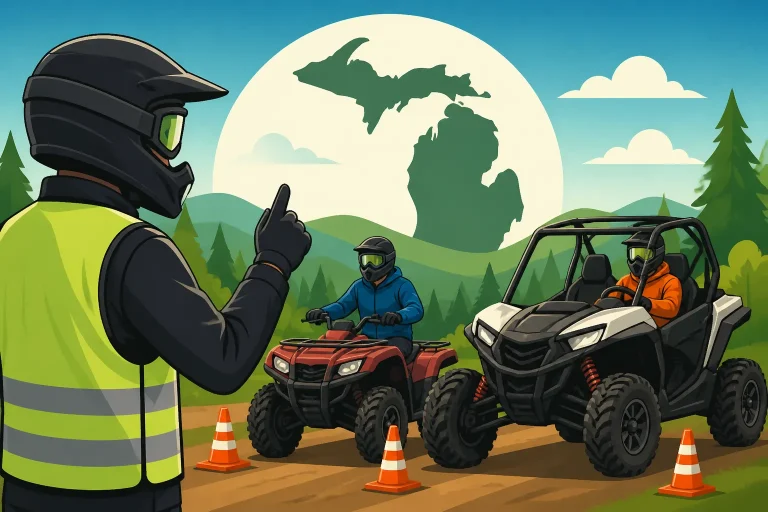
The Michigan Department of Natural Resources sets specific age and supervision rules for ORV use on public lands. According to the Michigan DNR, anyone under 16 operating an ORV on public lands must have a valid ORV safety certificate and be under an adult’s direct visual supervision. The DNR also says children under 10 may not operate four-wheel ATVs on public lands.
Those rules are important, but they do not answer every question about riding on a private parcel. Don’t assume the public-land rules establish a blanket minimum age for every private-property ride, and don’t assume that private property means there are no rules. First work out exactly where the machine will be ridden and whether the route crosses or enters a public trail, public land, or road.
| Where the ride takes place | What to keep in mind |
|---|---|
| Private land with controlled access | Confirm who owns or controls the land, that riding is permitted, and what requirements apply to the child and machine. |
| Public land | The Michigan DNR’s age, safety-certificate, and direct-supervision rules apply as described above. |
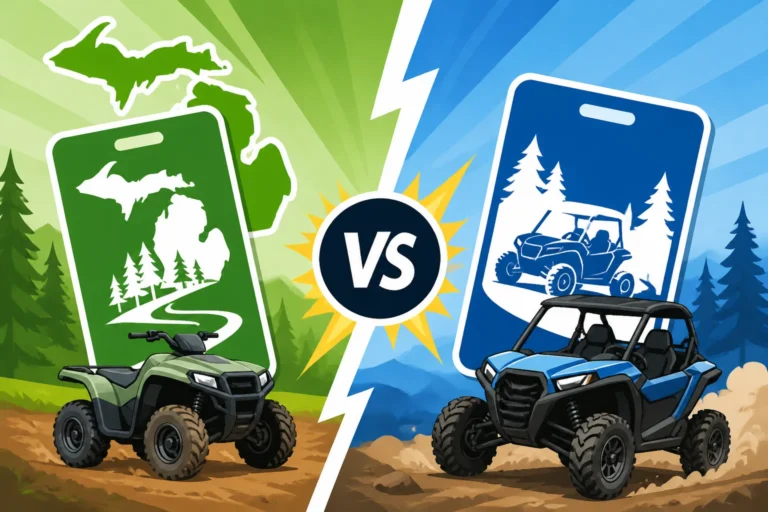
| A state-designated ORV trail | According to the Michigan DNR, using a state-designated ORV trail requires an ORV license and an additional trail permit; check current requirements before riding. |
| A public road designated for ORV use | Road-use rules may add requirements beyond those for private-property riding. Check the rules for the route and the rider’s age before entering it. |
A property can feel private without every part of a planned ride being private. A driveway, access lane, trail connection, or route to a public riding area may lead onto land with different requirements. State forest roads, for example, are not private property: the Michigan DNR says they are generally open to ORV use unless posted otherwise or seasonally closed. Check signs and closures rather than relying on the property owner’s description of a route.
For a closer look at the public-land age thresholds, see Michigan Age Rules at 10, 12 and 16 and Michigan ORV Age Rules for Young Riders. If the ride includes a public trail, Michigan ORV Safety Certificate for Riders Under 16 explains why a certificate is part of the eligibility question, not just a training recommendation.
How to check whether a private-property ride is actually private
Before deciding whether a child may ride, define the riding area. Ask the property owner where riders may go, whether the permission covers the whole route, and whether any part of the route reaches a public road, trail, or neighboring property. If you own the land, make the same map for yourself: a machine can cross a boundary quickly, especially on a loop that follows an access road or fence line.
Permission matters, too. A parent’s approval is not the same as permission from the person who controls the land. If the property belongs to someone else, get clear permission before unloading or riding. Be specific about which machines may be used, where they may travel, whether guests may ride, and what areas are off limits. A verbal “go ahead” can leave room for misunderstanding; a clear written agreement is easier for everyone to follow.
If the ride reaches a public area, pause and check the requirements for that section before continuing. An adult’s presence on private land does not automatically establish that the rider meets public-land rules. According to the Michigan DNR, a rider under 16 on public lands needs a valid ORV safety certificate and direct visual supervision by an adult; children under 10 cannot operate four-wheel ATVs there. For a friend’s land, Riding on a Friend’s Land Without a Michigan Permit can help identify the questions to ask about access and permits.
A useful pre-ride check is to confirm:
- The exact property boundaries and approved riding area.
- Who has authority to grant permission.
- Whether the route touches public land, a designated trail, or a public road.
- Which age, training, permit, and equipment requirements apply to each part of the route.
- Whether the landowner or insurer has set additional restrictions.
When the boundary or status of a route is uncertain, don’t ride it until you confirm. A map, posted sign, property owner, or appropriate public agency can help resolve uncertainty. Don’t rely on a trail’s appearance or on the fact that other riders use it as proof that it is open to your machine.
Supervision, training, and choosing a suitable machine
Even where a public-land rule does not settle the private-property question, a child’s readiness is still a practical safety issue. Consider whether the rider can reach and operate the controls, understand instructions, stop reliably, and respond calmly if the machine stalls or tips. A machine that is too large or powerful for the rider can make ordinary turns and stops harder to manage. Use the manufacturer’s rider guidance and have the child demonstrate basic control in a clear, level area before allowing a longer ride.
Supervision should be active rather than symbolic. A responsible adult should be close enough to see the rider and the route, give instructions, and respond if something goes wrong. For a younger or inexperienced rider, keep the route simple and separate the child from faster or larger machines. Set clear rules before the engine starts: where to ride, where to stop, what to do if separated, and when the ride ends.
A safety course can provide structured practice and a shared set of expectations. On public lands, the Michigan DNR requires anyone under 16 to have an approved ORV safety certificate, and the certificate must be carried while operating an ORV there. Even when the planned ride stays on private property, training can help a child learn safe habits before encountering trail traffic, uneven ground, or changing conditions. See Supervising a Young Rider on the Trail for practical supervision ideas and Youth ATV Size Rules Michigan Parents Should Know for machine-fit considerations.
An ATV and a UTV are not interchangeable from a passenger-safety standpoint. Michigan law does not allow an ORV to carry a passenger unless its design or manufacturing standards provide for passengers, according to the Michigan Legislature. Do not add a second rider to a machine designed for one just because the route is short or the land is private. For a UTV, make sure each occupant uses the seating and restraints intended for that machine.
Protective gear still deserves attention. Michigan law generally requires ORV operators and passengers to wear a DOT-approved crash helmet and protective eyewear, but the Michigan Legislature describes exceptions, including certain private-property use with permission and certain UTVs equipped with an approved roof and properly fastened safety belts. An exception is not a reason to skip protection without checking that the exact conditions are met. If buying gear through Amazon or another retailer, verify that the helmet’s labeling and fit meet the applicable requirement rather than relying only on a product title or seller description.
Other rules and risks that can matter on private land
A private location does not make every operating risk disappear. Before riding, inspect the route for fences, ditches, water, traffic, loose gravel, steep slopes, and obstacles hidden by grass or brush. Keep the riding area away from places where people may walk or work, and set a stop signal that everyone understands. If weather makes the surface slick or muddy, shorten or postpone the ride rather than letting a young operator learn on an unpredictable route.
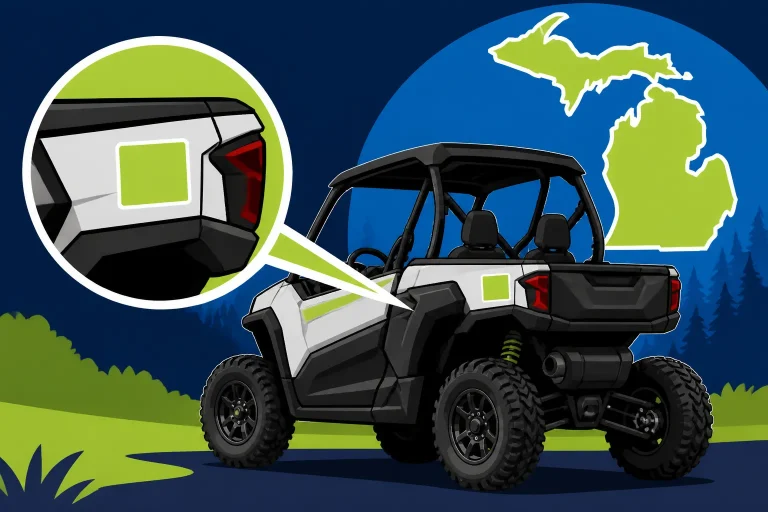
Some public-use equipment and operating rules may become relevant if the route leaves private land. For example, the Michigan Legislature requires a U.S. Forest Service-approved spark arrester and a muffler in good working order and constant operation on ORVs operated on public lands. The Legislature also requires a lighted headlight and taillight during the period from a half-hour after sunset to a half-hour before sunrise. Check the machine and route before relying on a private-land ride continuing after dark or connecting to public land.
Alcohol and impairment are not compatible with operating an ATV or UTV. According to the Michigan Legislature, Michigan’s legal blood alcohol concentration limit for ORV operation is 0.08 grams or more per 100 milliliters of blood, per 210 liters of breath, or per 67 milliliters of urine. The safest approach for a family ride is to keep the operator sober and alert, and to make sure an adult supervising a child can respond quickly.
Insurance and liability are also worth checking before a child rides someone else’s machine or property. Ask the property owner and your insurer whether the planned use is covered, and whether there are exclusions for youth operators, guests, particular machines, or certain terrain. Do not assume a policy covers an activity simply because it covers the ATV or UTV itself. If the ride involves public access, a permit question, or a roadway, review the relevant requirements separately; Michigan ORV Permit Exemption on Private Land is a useful related topic, but confirm how the rules apply to the exact location and use.
A simple decision process keeps the issue manageable:
- Pin down the full route and verify that it stays on land where riding is permitted.
- Identify whether any segment is public land, a state-designated trail, or a public road.
- Check the rider’s age, training, supervision, machine fit, passenger setup, and protective equipment against the requirements for each segment.
- Confirm permission and insurance for the planned use.
- If any part is unclear, pause and verify before riding.
The practical takeaway is to treat private-property access and public-land eligibility as separate questions. Permission to ride on a parcel does not, by itself, tell you what rules apply once the machine reaches a public route. Confirm the boundary, match the child and machine appropriately, and keep an adult actively involved.
Sources
- Michigan Department of Natural Resources — Purchase permit, learn requirements – State of Michigan (checked October 28, 2026)
- Michigan Legislature — MCL Section 324.81134 (checked October 28, 2026)
Disclaimer
This article is for general informational purposes only and does not constitute professional advice. Laws, prices and regulations vary by location and change over time. Consult a qualified professional for guidance on your specific situation.