Recreation Passport at Michigan Trailhead Lots
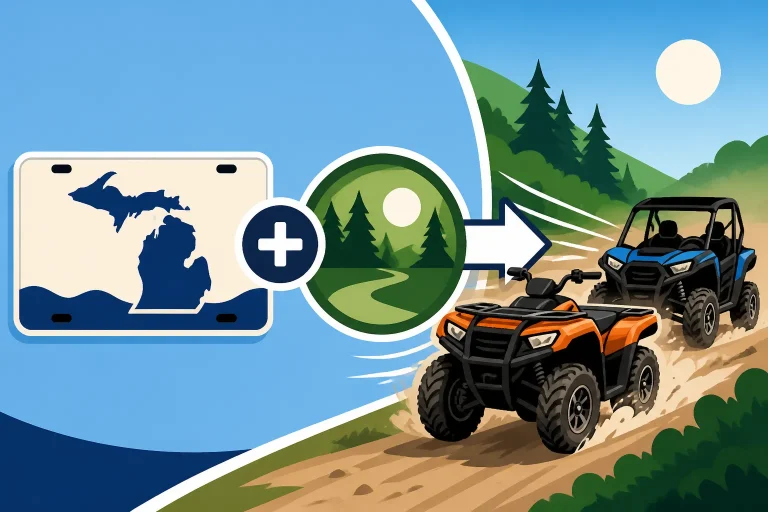
A trailhead parking question can get confusing when Michigan requires different permissions for the vehicle you drive to the lot and the ATV or UTV you unload there. The key distinction: a Recreation Passport covers parking at certain state-managed trailheads; it does not replace the ORV license or trail permit needed for riding.
When a Recreation Passport applies at a trailhead
According to the Michigan Department of Natural Resources, a Recreation Passport is required for motor vehicles parking at state-designated trailheads managed by the DNR. The important details are who manages the lot and whether it is a state-designated trailhead—not simply whether a trail is nearby.
That distinction matters because a trail system can connect to places with different managers. A lot may be managed by the DNR, a local government, a private landowner, or another organization. The Recreation Passport requirement in the facts here applies to the DNR-managed, state-designated trailhead lots. Don’t assume every place where riders park has the same rule.
| Your situation | What to check |
|---|---|
| You park a motor vehicle at a state-designated trailhead managed by the DNR | The DNR requires a Recreation Passport for that parking. |
| You unload an ATV or UTV and ride on designated ORV trails | Check the ORV license and trail permit requirements separately. |
| You park at a lot whose manager or designation is unclear | Check posted signs or ask the site manager before leaving the vehicle. |
| You use a different access point for the same trail system | Confirm the rules for that specific lot; access points may have different managers. |
A Recreation Passport is a site-access and parking requirement in this context. It is not the ORV license or trail permit that applies to riding. For a closer comparison of those riding credentials, see Recreation Passport vs ORV Trail Permit in Michigan and Michigan ORV License and Trail Permit Explained.
The practical takeaway is to check the parking location itself. A trail map can show where a route runs, but it may not tell you who manages a particular parking area or whether it is a state-designated trailhead. Look for signs at the entrance and check the DNR’s information for the site before your trip.
Recreation Passport and ORV riding permits are separate
It helps to think of the outing as involving two separate vehicles or activities:
- The motor vehicle you use to reach and park at the trailhead.
- The ATV or UTV you operate after unloading it.
The Recreation Passport requirement described by the DNR applies to the motor vehicle parked at a qualifying trailhead. ORV licensing and trail permits relate to operating the off-road vehicle. Having one does not automatically satisfy the other.
According to the Michigan Department of Natural Resources, the annual ORV license costs $26.25, and riding on state-designated ORV trails requires an additional $10.00 trail permit, for a combined total of $36.25, as of October 2026. The DNR also states that annual ORV licenses and trail permits expire on March 31 of the following year, regardless of when they were purchased. Those amounts and expiration rules concern ORV credentials, not the Recreation Passport.
The Recreation Passport’s current cost and purchase options are separate details. Check the DNR for current figures and instructions rather than using an old receipt or assuming that an ORV permit purchase includes it. For information about those separate ORV credentials, see Michigan Recreation Passport Cost and Renewal and Michigan ORV License Cost and What It Covers.
A useful way to plan is to make two checks before leaving home:
- Check the lot. Confirm that your chosen parking area is a state-designated trailhead managed by the DNR, and determine whether your motor vehicle needs a Recreation Passport there.
- Check the machine. Confirm the ORV license and trail permit requirements for the route or area where you plan to ride.
- Check the site on arrival. Follow posted parking instructions and any temporary closure or access notices.
This avoids a common mix-up: seeing a valid ORV sticker on the ATV and assuming it also covers the truck or other motor vehicle in the trailhead lot. The riding credential and the parking requirement serve different purposes.
If the trailhead serves more than one route or recreation area, don’t assume the rules are identical across every connected access point. Confirm the status of the specific lot where you intend to leave your vehicle. Michigan ORV Trailhead Parking Rules can help with the broader parking questions, while Michigan ORV Trail Maps and What the Signs Mean is useful for understanding route information and trail signs.
How to verify the right parking rule
Before setting out, identify the exact trailhead rather than relying on a general search for a nearby trail. The name of a trail network and the manager of its parking lot may not be the same thing. If you cannot tell from available site information, use posted contact details or ask the managing agency.
At the lot, read signs at the entrance and in the parking area. A sign may confirm the site’s status, explain how to satisfy the Recreation Passport requirement, or direct visitors to a different payment or access process. Follow the instructions for the vehicle you parked, not just the rules posted for the ORV route.
Keep the parking check distinct from the ride check. A Recreation Passport does not establish that an ATV or UTV is properly licensed for the trail. Likewise, an ORV license or trail permit does not, by itself, answer whether the motor vehicle parked at a qualifying DNR trailhead has the required Recreation Passport.
State forest roads are another reason to verify the location instead of relying on a broad assumption. According to the Michigan Department of Natural Resources, state forest roads are generally open year-round to ORV use unless otherwise posted or seasonally closed. That describes ORV access on those roads; it does not establish that a nearby parking lot is a state-designated trailhead or settle its Recreation Passport requirement.
Closures can also change access plans. According to the Michigan Department of Natural Resources, the agency has authority to close state trails and facilities because of weather-related events and wet conditions. Check for current notices before driving to the lot, and pay attention to signs on arrival. A closure or temporary access notice may matter even if you have the correct parking and riding credentials.
For trips involving a non-DNR parking area, ask its manager what applies there. The DNR trailhead rule should not be extended automatically to a private lot or a lot managed by a local authority. At the same time, don’t assume that a different manager means there are no parking rules; confirm the requirements for that particular location.
A simple pre-trip checklist
Use this checklist when planning a trail ride:
- Name the parking location. Make sure you know the exact trailhead or access point, not only the trail system.
- Confirm who manages the lot. The stated Recreation Passport requirement is for motor vehicles parking at state-designated trailheads managed by the DNR.
- Check the Recreation Passport instructions. Confirm current cost, purchase or display steps, and any site-specific directions with the DNR.
- Check the ORV credentials separately. If your route uses state-designated ORV trails, review the ORV license and additional trail permit requirements. Where to Buy a Michigan ORV License covers the license-purchase question.
- Review closures and posted restrictions. A trail or facility may be unavailable because of weather, wet conditions, seasonal closure, or another posted restriction.
- Recheck when you arrive. Follow the signs for the lot and the route, even if you checked the location in advance.
If you are choosing between parking areas, compare them one at a time. One lot may be a DNR-managed state-designated trailhead, while another access point for the same general riding area may have a different manager. The Recreation Passport question follows the parking site’s status, so using a different lot can change which instructions apply.
When the lot’s status is uncertain, ask before you park. That is more reliable than guessing from the name of the trail, the kind of vehicle you brought, or the permit sticker on your ATV. Keep the parking requirement and the ORV riding credentials as separate checks, and you can arrive knowing what each one covers.
Sources
- Michigan Department of Natural Resources — ORV FAQs – State of Michigan (checked October 28, 2026)
- Michigan Department of Natural Resources — Purchase permit, learn requirements – State of Michigan (checked October 28, 2026)
Disclaimer
This article is for general informational purposes only and does not constitute professional advice. Laws, prices and regulations vary by location and change over time. Consult a qualified professional for guidance on your specific situation.