Michigan ORV Permit for National Forest Roads
Michigan ORV Permit for National Forest Roads
Planning to ride a Michigan National Forest road can raise a basic but easy-to-miss question: do you need both an ORV license and a trail permit? The answer depends on whether you are using an eligible forest road or a designated ORV trail. Here’s how to tell the permits apart, check your route, and prepare before you ride.
The permit rule for eligible National Forest roads
According to the Michigan Department of Natural Resources, riding an eligible National Forest road in Michigan requires a standard Michigan ORV license. You do not need the additional ORV trail permit simply to drive on an eligible forest road. The trail permit is required when you operate on designated ORV trails or scramble areas.
The distinction is about the route, not just the kind of machine you own. An ATV or UTV does not automatically qualify for every road or trail. Before setting out, confirm that the road is open to your machine and that your planned route does not include a designated ORV trail or scramble area.
| Where you plan to ride | Michigan permit rule | What to verify |
|---|---|---|
| Eligible National Forest road | A standard Michigan ORV license is required; an additional trail permit is not required just for the road | That the road is eligible and open to your vehicle |
| Designated ORV trail | The standard ORV license and additional trail permit are required | Whether the route is officially designated as a trail |
| Scramble area | The standard ORV license and additional trail permit are required | Whether the riding area is open and what local requirements apply |
This is why it helps to separate a road ride from a trail ride when planning. A route can include more than one type of segment, and the permit requirement can change when you leave an eligible forest road for a designated trail. Check the whole route rather than assuming one permit rule covers every surface.
For a broader overview of how the permits work, see Michigan ORV License and Trail Permit Explained. If your plans are limited to roads rather than trails, Michigan ORV Permit for State Forest Roads Only may help clarify the separate rules for state forest roads. State forest roads and National Forest roads are not interchangeable categories: the Michigan DNR says state forest roads are generally open year-round unless posted otherwise or seasonally closed, but that statement does not establish that a National Forest road is open.
The base license and trail permit are separate
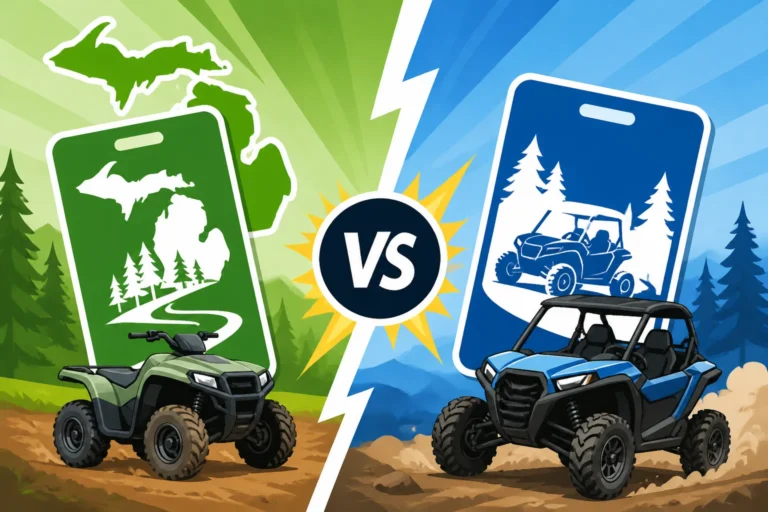
The ORV license is the standard requirement for the eligible National Forest road ride described by the Michigan DNR. The trail permit is an additional permit for designated ORV trails and scramble areas, not a replacement for the base license.
As of October 2026, the Michigan DNR lists the annual ORV license at $26.25 and the additional trail permit at $10.00, for a combined total of $36.25 when both are needed. If you are riding only on eligible National Forest roads, the additional trail permit is not required just for those roads; if your plan includes designated ORV trails or scramble areas, the additional permit applies.
Annual Michigan ORV licenses and trail permits expire on March 31 of the following year, regardless of when they were purchased, according to the Michigan DNR. A permit bought partway through the season does not extend the expiration date. Before a later ride, check that your license remains valid and whether the route requires a trail permit.
For help deciding when both permits are needed, see Do You Need Both a License and a Trail Permit in Michigan?. If you’re trying to understand what the base license covers without a trail permit, Michigan ORV License Without a Trail Permit: Where You Can Ride is also relevant.
Check the route before you leave
“National Forest road” is not a blanket permission to ride every road in or near a forest. The Michigan DNR’s permit rule applies to eligible National Forest roads. You still need to confirm that the particular road is open to ORV use and that your machine fits the route’s designation.
Before leaving, check current official maps, road designations, posted restrictions, and closure notices for the area. Pay attention to where a road ends and a designated trail begins. If your planned route crosses onto a trail or enters a scramble area, the additional trail permit requirement applies there, even if the ride began on an eligible road.
Weather can change access as well as route plans. The Michigan DNR has authority to close state trails and facilities because of weather-related events and wet conditions. That fact concerns state-managed trails and facilities; do not assume it describes the closure rules for every National Forest road. Check the relevant official notices for the place you intend to ride.
A route-planning checklist can keep the permit question straightforward:
- Confirm that the specific road is open to ORV use.
- Identify any designated ORV trails or scramble areas on the route.
- Carry the standard Michigan ORV license required for eligible National Forest roads.
- Add the trail permit if you will ride a designated ORV trail or scramble area.
- Recheck notices close to departure in case closures or conditions have changed.
The distinction between route types is easy to lose when a map shows roads and trails together. Michigan ORV Trail Maps and What the Signs Mean can help with interpreting trail information, while Michigan ORV Trail Closure Notices is useful when conditions or closures could affect your plans.
Confirm the vehicle’s width and access
Machine size can affect whether a route is suitable. The Michigan Department of Natural Resources designates three ORV trail types by width: motorcycle-only trails maintained at a 24-inch width, trails maintained at a 50-inch width, and ORV routes maintained at a minimum 72-inch width. Those definitions do not mean every road or trail accepts every vehicle width.
Check the specific route designation for your machine rather than relying on a general description such as “ORV access.” This is particularly important when riding a wider side-by-side: road access and designated trail access may have different limits or restrictions. If the route information is unclear, get clarification from the authority responsible for the road or area before riding.
Prepare the machine and riders
Having the correct permit is only part of being ready to ride. Michigan’s safety rules apply on public lands, including eligible forest roads, and a machine that is not properly equipped can create a safety or compliance problem even when the permit is correct.
Michigan law requires public-land ATVs to have a United States Forest Service-approved spark arrester and a muffler in good working order and constant operation, according to the Michigan Legislature. Inspect those parts before the trip and do not assume a quiet-looking exhaust system meets the requirement. If you are comparing replacement parts on Amazon or elsewhere, verify that the part is approved for the intended use and fits your machine; check the product details rather than relying on a broad compatibility claim.
The Michigan Legislature also sets ORV exhaust noise limits at 94 dB(A) for vehicles manufactured after January 1, 1986, and 99 dB(A) for older models when tested using the SAE J1287 stationary test procedure. Keep the exhaust system in working order and confirm that any modifications do not create a compliance issue.
Helmet and passenger rules matter too. According to the Michigan Legislature, ORV operators and passengers generally must wear a Department of Transportation-approved crash helmet and protective eyewear. An exception can apply in a UTV equipped with an approved roof when occupants are wearing properly adjusted and fastened safety belts. The exception is conditional; it does not mean that every UTV roof or any loosely worn belt qualifies.
A passenger may ride only if the vehicle’s design or manufacturing standards provide for carrying passengers, according to the Michigan Legislature. Do not carry someone on a machine intended for a single rider just because there is room to sit. Follow the vehicle’s designated seating and restraint arrangements.
Other practical checks include:
- Make sure the machine’s headlight and taillight work. The Michigan Legislature prohibits operating an ORV without a lighted headlight and taillight from a half-hour after sunset to a half-hour before sunrise.
- Check that the exhaust and spark arrester are secure and in working order.
- Use a helmet and protective eyewear unless a specific legal exception applies.
- Keep passengers in manufacturer-provided seating and use required restraints.
- Avoid riding after drinking. Michigan law sets the ORV blood alcohol concentration limit at 0.08 grams or more per 100 milliliters of blood, per 210 liters of breath, or per 67 milliliters of urine, according to the Michigan Legislature.
The last point is not a recommendation to ride up to a legal limit. Alcohol can impair judgment and control before a rider reaches the statutory threshold. Plan a sober ride and do not operate if you are impaired.
Youth riders and a final pre-ride check
Age and supervision rules are another reason to plan ahead, especially when a group includes a young rider. According to the Department of Natural Resources, anyone under 16 must have a valid ORV safety certificate and be under the direct visual supervision of an adult to operate an ATV unsupervised on public lands. The DNR also says children under 10 may not operate four-wheel ATVs on public lands.
The Department of Natural Resources requires youth under 16 to complete an approved ORV safety course and carry their safety certificate while operating an ORV on public lands. Do not treat the certificate as a substitute for the supervision requirement: the rules include both the certificate and direct visual supervision for the riders covered by that requirement.
A road being open to ORVs does not remove those youth requirements. Make sure the adult supervising can maintain direct visual supervision, and choose a route and pace that suit the rider. For more on the rules that apply to younger operators, see Michigan ORV Age Rules for Young Riders and Michigan ORV Safety Certificate for Riders Under 16.
Before departure, use this final check:
- Confirm the road is eligible and currently open to ORVs.
- Decide whether the route also includes a designated ORV trail or scramble area.
- Carry a valid Michigan ORV license; obtain the additional trail permit if the route requires it.
- Check the license expiration date, since Michigan permits expire on March 31 of the following year under the DNR rule.
- Confirm that the machine’s width and seating arrangement fit the route and intended riders.
- Check the spark arrester, muffler, lights, helmet, eyewear, and seat belts as applicable.
- Make sure each young rider has the required certificate and supervision.
When the road classification or access status is uncertain, pause and verify before riding. Guessing that a road is open—or that a trail permit is unnecessary for every part of a mixed route—can leave you with the wrong permit or on a route your machine should not use. A little route checking helps keep the ride within the rules and avoids confusing National Forest roads with designated ORV trails.
Sources
- Michigan Department of Natural Resources — ORV FAQs – State of Michigan (checked October 28, 2026)
- Michigan Department of Natural Resources — Purchase permit, learn requirements – State of Michigan (checked October 28, 2026)
- Michigan Legislature — MCL Section 324.81133 (checked October 28, 2026)
- Michigan Legislature — MCL Section 324.81134 (checked October 28, 2026)
Disclaimer
This article is for general informational purposes only and does not constitute professional advice. Laws, prices and regulations vary by location and change over time. Consult a qualified professional for guidance on your specific situation.