Michigan ORV License and Trail Permit Total Cost
Michigan’s ORV paperwork can look like one permit, but the total cost depends on where you plan to ride. The annual ORV license and trail permit are separate parts of the system, and the trail permit is not required for every kind of ORV use. Here’s what the combined cost covers, when you may not need both, and how to avoid paying for the wrong riding area.
Michigan ORV license and trail permit cost
According to the Michigan Department of Natural Resources, the annual ORV license costs $26.25, and the additional trail permit costs $10.00. If you plan to ride state-designated ORV trails, the combined total is $36.25. Those amounts are listed as of October 2026.
| Item | Cost | What it covers |
|---|---|---|
| Annual ORV license | $26.25 | The base license |
| ORV trail permit | $10.00 | Additional permission for riding state-designated ORV trails |
| License and trail permit together | $36.25 | The combined cost for trail riding |
The Michigan Department of Natural Resources requires the trail permit to be purchased along with the base ORV license for a total of $36.25 when riding state-designated trails. The extra permit is not simply another name for the license: each serves a different purpose. For a fuller explanation of how the two fit together, see Michigan ORV License and Trail Permit Explained.
The cost is annual, not a fee that extends for a full year from the day you buy it. According to the Michigan Department of Natural Resources, annual ORV licenses and trail permits expire on March 31 of the following year, regardless of when they were purchased. Buying later in the season therefore does not move the expiration date forward.
That timing matters if you are deciding whether to buy now or wait. If you buy shortly before the annual expiration, you still need to plan for renewal if you intend to keep riding after that date. Check the Michigan Department of Natural Resources’ current information before purchasing, particularly if your trip falls near the end of the permit year.
For most riders who expect to use designated ORV trails, the combined total is the straightforward budget figure. If you have a different kind of riding planned, check the rules for that specific area before assuming the trail permit is required—or assuming it is not.
When you need both permits, and when the trail permit does not apply
The key distinction is the place and type of riding. The $10.00 trail permit is an additional requirement for state-designated ORV trails; the base ORV license remains a separate part of the cost. A trail permit should not be treated as a universal charge for every ride, but neither should a rider assume that a particular road, route, or public area is exempt just because it is not called a trail.
| Planned use | What the official information says | Practical takeaway |
|---|---|---|
| State-designated ORV trails | The Michigan Department of Natural Resources says the additional $10.00 trail permit is required along with the $26.25 license. | Budget for the $36.25 combined total. |
| Frozen surface of public waters | The Department of Natural Resources says an ORV license is required, but a trail permit is not required for this use. | The trail permit is not part of the stated requirement for this specific activity. |
| State forest roads | The Michigan Department of Natural Resources says these roads are generally open to ORV use year-round unless posted otherwise or seasonally closed. | Check the road’s status and permit rules; open access alone does not establish a trail-permit exemption. |
| Other public or private riding areas | Requirements depend on the applicable rules and the location. | Confirm the rules for the exact place you intend to ride. |
For riders who only plan to operate on the frozen surface of public waters, the Department of Natural Resources says the ORV license is required and the trail permit is not. That is a specific exception, not a general rule for all riding away from marked trails. If you want to compare situations where the trail permit is not part of the stated requirement, see Michigan ORV License Without a Trail Permit: Where You Can Ride.
State forest roads are another case that can cause confusion. The Michigan Department of Natural Resources says they are generally open year-round unless a road is posted otherwise or closed seasonally. That information describes access; it does not, by itself, say that every road is exempt from a permit. Check the rules for the road and the route you plan to use rather than relying on the general opening rule alone.
Private land also needs a separate check. Do not assume that a rule for private property automatically applies to public trails, or that permission from a landowner answers every permit question. For the separate topic of private-land exemptions, see Michigan ORV Permit Exemptions on Private Land.
The same care applies to out-of-state riders. Being licensed or permitted in another state does not automatically establish which Michigan requirements apply. Riders visiting from elsewhere can use ORV Permits for Out-of-State Riders in Michigan as a starting point, then confirm the rules for their own status and intended riding area.
Buying and timing your permits
Before purchasing, decide where you are actually going to ride. If your itinerary includes state-designated ORV trails, budget for the combined cost of $36.25. If your planned use is limited to the frozen surface of public waters, the Department of Natural Resources says an ORV license is required but a trail permit is not. If the route includes roads, forest access, or other public areas, verify the requirements for those places rather than making the decision based only on the word “trail.”
A practical way to plan is:
- Identify the specific route, trail, or riding area you intend to use.
- Check whether it is a state-designated ORV trail or a different type of access.
- Confirm whether the base ORV license and the additional trail permit are required for that use.
- Check the expiration date before buying, especially if your ride is near the end of the permit year.
- Keep the required permit information with your riding paperwork and make sure each operator meets the applicable safety rules.
According to the Michigan Department of Natural Resources, the license and trail permit expire on March 31 of the following year even if purchased later. For an explanation of the annual cycle, see Michigan ORV Permit Year: April 1 to March 31. Do not assume a purchase made late in the season will remain valid for a full year after the transaction.
If you are unsure where to complete the purchase, use Where to Buy a Michigan ORV License to review the available options. Before paying, check the official information for the current amount and make sure you select the items that match your riding plans. The combined cost is easy to budget for, but buying only the base license when your plan includes designated trails can leave you without the additional permit required for that use.
The permit cost is only one part of preparing to ride. According to the Department of Natural Resources, anyone under 16 must complete an approved ORV safety course and carry a valid safety certificate to operate an ORV on public lands. The department also says operators under 16 must be under an adult’s direct visual supervision, and children under 10 are prohibited from operating four-wheel ATVs on public lands. Those requirements are separate from the license and permit cost.
Avoiding the costliest permit mistake
The simplest mistake to avoid is treating the license and trail permit as interchangeable. The Michigan Department of Natural Resources lists the annual license at $26.25 and the additional trail permit at $10.00; for designated trail use, the combined amount is $36.25. Buying the base license alone does not satisfy the stated trail-permit requirement for those trails.
The opposite mistake is assuming every ORV outing requires the same combination. The Department of Natural Resources says no trail permit is required for ORV use on the frozen surface of public waters, though the ORV license is required. For other kinds of riding, check the applicable location and rules rather than extending that narrow exception to a different setting.
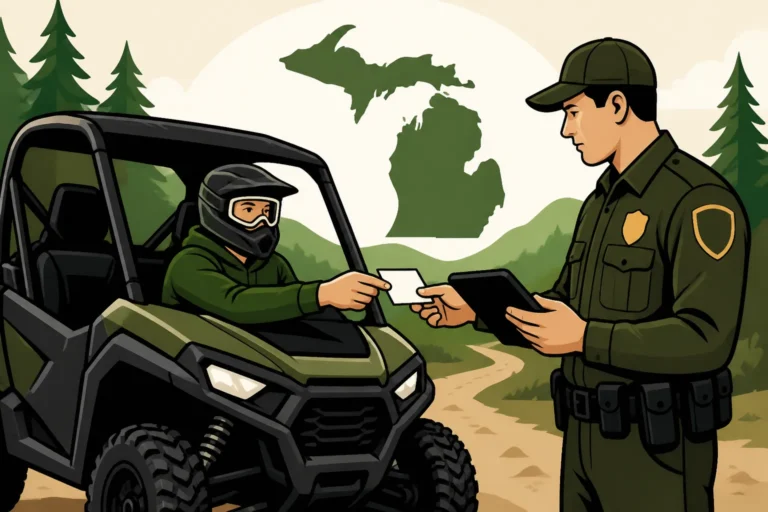
Riding without a required trail permit can also cost more than the permit itself. According to the Michigan Legislature, operating an ORV without a required trail permit is a state civil infraction carrying a civil fine of not more than $500. The fine is not the same as the purchase price, and avoiding it starts with confirming the permit requirement before the ride. For more on enforcement, see Michigan ORV Permit Checks by Conservation Officers.
Keep the permit question separate from other rules that affect whether a ride is legal. Helmet, passenger, lighting, and safety-certificate requirements do not change the permit price, but they can still apply to the trip. The Michigan Legislature says ORV operators and passengers generally must wear a Department of Transportation-approved crash helmet and protective eyewear, with exceptions in certain conditions. Its rules also prohibit carrying a passenger unless the vehicle’s design or manufacturing standards provide for passengers. Check the requirements for your machine and riding situation before heading out.
A clear pre-ride check prevents both unnecessary spending and missing paperwork: confirm the route, confirm whether it is a designated trail, check the annual expiration date, and verify the rules for the people riding. If the trip includes designated ORV trails, use $36.25 as the combined cost figure provided by the Michigan Department of Natural Resources. If it does not, look up the requirement for that specific use instead of assuming that the trail permit always applies.
Sources
- Michigan Department of Natural Resources — ORV FAQs – State of Michigan (checked October 28, 2026)
- Michigan Department of Natural Resources — Purchase permit, learn requirements – State of Michigan (checked October 28, 2026)
- Michigan Legislature — Michigan Compiled Laws, Section 324.81147 (checked October 28, 2026)
Disclaimer
This article is for general informational purposes only and does not constitute professional advice. Laws, prices and regulations vary by location and change over time. Consult a qualified professional for guidance on your specific situation.