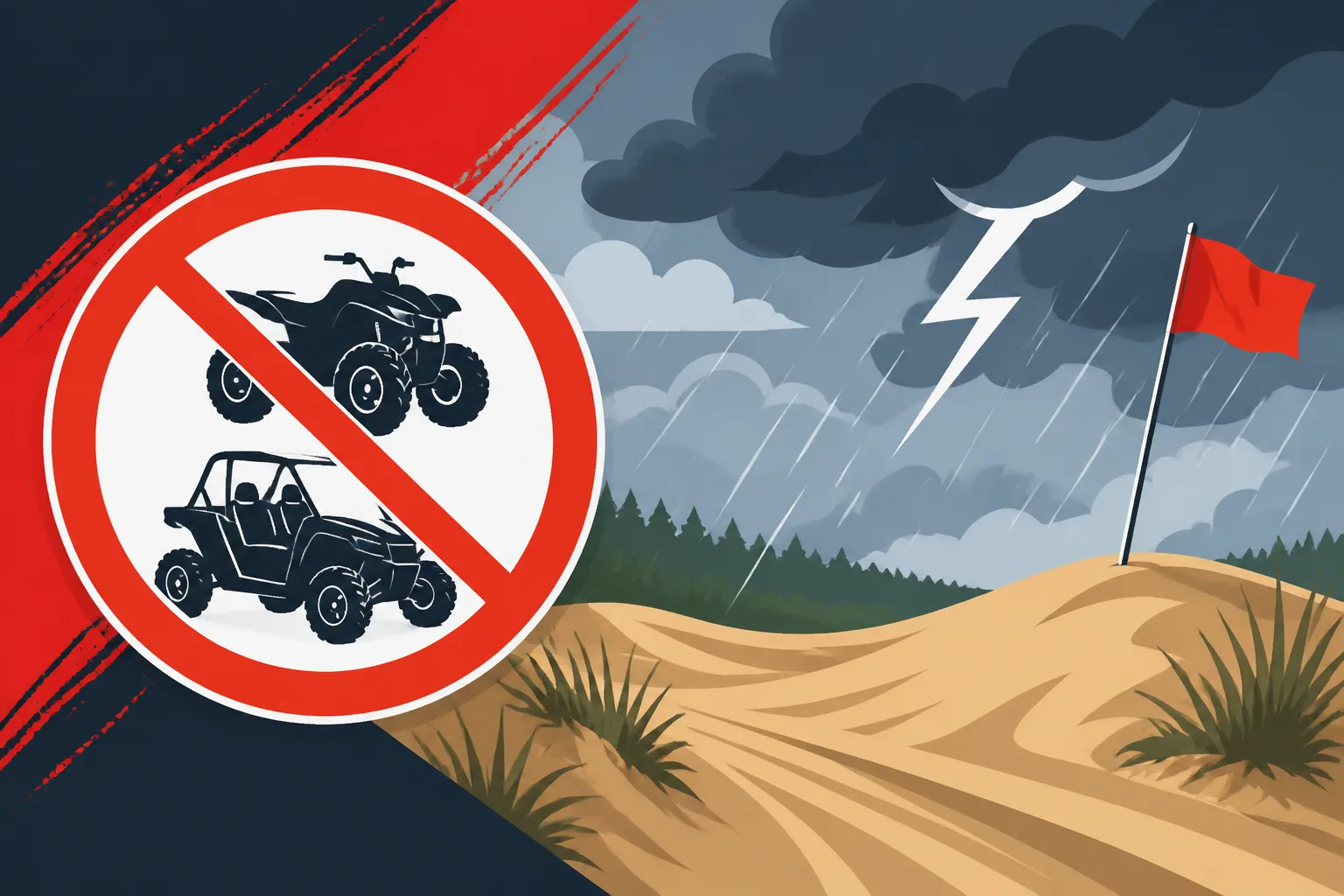
Silver Lake Dune Closures for Weather
A weather closure at Silver Lake can upend a dune-riding day just as you arrive in Mears, especially after a long drive with a trailer or a rental booking. This guide explains why the riding area may close, how to check its status, what to do if weather changes your plans, and how to avoid mistaking a map or forecast for an official reopening notice.
Why Weather Can Close the Silver Lake Dunes
Silver Lake State Park’s ORV area is a managed riding area, not an open stretch of beach where riders can decide for themselves that conditions are safe. Weather can affect visibility, footing, traffic flow, and the ability to respond to an incident. Park staff may restrict access or close the area when conditions call for it.
A forecast can help you plan, but it does not tell you whether the gates are open. A sunny afternoon forecast does not guarantee that the area will be operating when you arrive, and a passing shower does not automatically mean it is closed. Treat the posted status and directions from park staff as the authority.
Weather conditions that can affect a ride
Weather risks can be direct, such as lightning or strong winds, or indirect, such as rain changing the surface and visibility. Wind can blow sand across tracks and make it harder to see other vehicles. Rain can affect traction and create rough or unpredictable conditions in heavily traveled areas. Storms may also bring a rapid change from manageable riding conditions to conditions where drivers need to stop and seek guidance.
These are examples of possible concerns, not a fixed public checklist of automatic closure triggers. The decision to close, limit, or reopen an area rests with park staff. A rider’s assessment from the parking lot, or a forecast app’s general description of the weather, cannot replace that decision.
Conditions can also vary across the day. A calm morning does not guarantee that the afternoon will stay calm, and a brief lull between rain bands does not mean a closure has ended. If weather is unsettled, keep checking official updates rather than making a one-time decision before leaving home.
A closure may affect access in different ways
A weather-related change may mean a full closure, a temporary pause, or a restriction on some access. Do not assume that a closure is limited to the area you can see from the entrance, or that a quiet entrance means riding is permitted. Follow signs, barriers, and instructions from park staff.
It also helps to distinguish an ORV-area closure from general weather conditions around Silver Lake. A beach, campground, trail, or nearby business may be open while ORV riding is restricted, or the reverse may be true. Check the status of the specific place and activity you plan to use.
Before making a detailed itinerary, review [Silver Lake ORV Area Hours and Season Dates]. Normal operating hours and seasonal dates are useful background, but they do not override a weather closure or a temporary restriction.
How to Check Whether the Riding Area Is Open
The most frustrating part of a possible closure is uncertainty: one app says the weather is clearing, a social post from earlier in the day shows riders on the dunes, and you still do not know whether you can enter. Build your decision around current park information, not scattered reports or old photos.
Check official park information before leaving
Start with Michigan DNR information for Silver Lake State Park and any official park alerts or notices available for the area. If the status is unclear, contact the park using its published contact information before you load up. On arrival, pay attention to signs at the entrance and follow directions from staff.
When you call or check an update, ask a specific question: Is the ORV area open for riding now? Is access fully open, restricted, or temporarily paused? Has staff issued any direction about weather-related changes? These questions are more useful than asking only whether the park is open, because other parts of the park may have a different status.
If you are traveling from farther away, check once before you depart and again while en route, provided you can do so safely. A closure or change can happen after your first check. Do not stop in traffic or use a phone while driving; have a passenger check, or pull over somewhere safe.
Use maps for planning, not for closure confirmation
Mapping tools can help you understand the region, plan a route to Mears, and save nearby points of interest. For example, onX Offroad can be useful for organizing your trip and reviewing mapped routes, but a map does not establish that Silver Lake’s ORV area is open. A saved track, a route line, or a recent-looking trail view should never be treated as permission to ride.
The same caution applies to crowd-sourced posts, photos, and group messages. A rider may have posted before a closure began, may be describing a different part of the park, or may not know that access has changed. Use onX Offroad as a planning aid, then confirm the operating status through official park information.
A simple check sequence can keep the decision clear:
- Check the forecast for Silver Lake and the surrounding Oceana County area.
- Check official park information for the ORV area’s operating status.
- Contact the park if the status or timing is unclear.
- Recheck before entering and follow posted instructions on site.
The forecast tells you what weather may be coming. The official status tells you whether riding is allowed.
Read updates carefully and check their timing
A closure notice may not answer every question at a glance. Look for the date and time of the update, the specific area named, and whether it describes a full closure or a temporary restriction. If the notice says conditions will be reassessed, do not interpret that as a guaranteed reopening time.
Photos and posts can be useful clues, but they are not a substitute for a current notice. A video of riders on the dunes may show conditions from hours earlier or a previous visit. If you cannot confirm the status, plan as though riding is not available until you receive clear direction.
For a busy day, it is worth checking the [Silver Lake Dune Entry Line Wait Times] guidance as well. A long entry line and a weather restriction are different issues, but both can affect how much riding time you actually get.
What to Do When Weather Changes Your Plans
A closure can be disappointing, particularly if you have booked a rental, brought children along, or built a weekend around the dunes. It is still better to lose part of a riding day than to push into unsafe conditions or ignore a closure. A flexible plan makes the decision easier and reduces the pressure to ride when the area is not operating.
If you are already at the entrance
Follow staff directions and do not try to enter around a barrier or find an informal route onto the dunes. A closure is not an invitation to wait for a gap in traffic or follow another vehicle. If access is paused, ask whether staff expect to reassess conditions and whether there is an official way to check for an update.
If weather is deteriorating, secure loose items, keep everyone together, and move to a safe place as directed. Dust, blowing sand, rain, and sudden drops in visibility can make a busy riding area especially difficult to navigate. Do not assume that a short walk onto the dunes is harmless while ORV access is closed; obey posted boundaries and instructions.
If staff announce that the area has reopened, take time to understand the directions before setting off. Conditions may still be changing. Review your machine and gear, make sure everyone understands the riding plan, and avoid rushing because you feel you have lost time.
If you are traveling with a rental
Call the rental shop as soon as you learn of a closure or possible delay. Ask how its weather and cancellation policies apply, whether your booking can be moved, and whether there is a deadline for changing the reservation. Policies differ, so get the answer directly from the business rather than relying on another renter’s experience.
If you booked a guided ride, ask the operator whether the activity is canceled, postponed, or being held pending a park update. Do not assume a rental or tour includes permission to ride during a closure. The park’s access rules still apply, regardless of who supplied the machine.
If you are still preparing for a later ride, use [What You Need to Ride the Silver Lake Dunes] and the [Silver Lake Dune Vehicle Requirements Checklist] to check your gear and vehicle. That preparation is useful, but it does not replace checking conditions on the day.
If you need a backup plan
Consider activities that do not depend on ORV access, such as spending time in the Silver Lake and Mears area, visiting local businesses, or adjusting your schedule for a later opening. Verify hours and access for any alternative before setting out, particularly if a storm is affecting the region. Do not assume that a nearby beach or park facility has the same status as the riding area.
If you are staying overnight, contact your lodging or campground about arrival timing and any weather-related changes that could affect your plans. A backup day in the area can make a closure less disruptive, especially for families who have traveled a long distance. For trip-planning ideas, see [Camping Near the Silver Lake Sand Dunes].
Planning a Safer and More Flexible Dune-Riding Day
Weather readiness is not only about packing rain gear. It means leaving room in your schedule, making sure everyone knows where to check updates, and accepting that the park may change access when conditions warrant it. That mindset is especially useful when the drive, rental, or group plans make it tempting to press ahead.
Make a pre-trip weather and status checklist
Use a short checklist the night before and again on the morning of your ride. Check the local forecast, confirm the park’s operating status, and make sure your group knows who will look for updates. If you are coordinating several vehicles, share one agreed-upon source of official information so people are not making decisions from different screenshots or old messages.
| Before you go | What to confirm | Why it matters |
|---|---|---|
| The day before | Forecast and planned arrival window | Helps you spot unsettled weather and consider a backup plan |
| Before departure | Current official ORV-area status | A forecast alone does not confirm access |
| While en route | Any new park notice or change | Conditions and access can change after your first check |
| At the entrance | Signs and staff instructions | On-site directions take priority over saved plans |
| Before riding | Gear, vehicle, and group plan | Helps prevent rushing after a delay or reopening |
Pack for changing conditions, but do not treat extra equipment as a reason to ride in a closure. A helmet, goggles, suitable clothing, water, and a charged phone can help with ordinary ride preparation; they cannot make restricted access acceptable or make poor visibility safe.
If you are new to the area, [Silver Lake Dune Riding for First-Timers] can help you prepare for the setting and the practical details of a first visit. For timing, [Best Time of Day to Ride Silver Lake Dunes] is useful for planning around your preferred riding window, but any timing advice remains secondary to the park’s current status.
Leave room for delays instead of forcing the schedule
A tight itinerary can turn a manageable delay into a stressful situation. If you have a rental return, dinner reservation, or long drive home, allow extra time rather than assuming you will be able to ride for a set number of hours. This matters on busy days, when entry queues, weather pauses, or changing conditions can reduce your time on the dunes.
For example, imagine arriving in Mears with a group reservation and seeing a notice that the ORV area is temporarily closed while conditions are assessed. The useful next step is not to debate whether the sky looks clear above the parking area. Check with staff, contact your rental provider, and decide whether waiting or switching plans works for your group. If a reopening is announced, follow the instructions and ride within the time and conditions available.
Likewise, if the forecast looks uncertain the night before, tell everyone in your group that the plan may change. That conversation can feel inconvenient, but it is much easier than asking a tired driver, impatient children, and several riders to make a rushed decision at the entrance.
Treat reopening as a fresh decision point
An update that the area has reopened does not mean you should ignore the weather around you. Reassess what you can see, listen to staff, and consider whether your group is prepared for the conditions. If visibility is poor, a rider feels uncomfortable, or weather is worsening, it is reasonable to sit out or end the ride.
Maps can still help you keep your trip organized after a change. onX Offroad may help with route planning and saved locations, but check official park guidance for access and any posted restrictions before riding. Use it to support preparation, not to make the final call on whether the dunes are open.
The safest approach is straightforward: forecasts help you prepare, maps help you plan, and park updates and on-site directions determine whether you may ride. Keep a backup plan, verify information close to arrival, and do not let a long drive or prepaid booking push you past a closure notice.
Disclaimer
This article is for general informational purposes only and does not constitute professional advice. Laws, prices and regulations vary by location and change over time. Consult a qualified professional for guidance on your specific situation.