Michigan’s Six ORV Scramble Areas
Michigan riders often want a place to climb, turn, and explore off-road without committing to a long trail loop, but “scramble area” can mean different things depending on who manages the land. This guide compares six Michigan destinations for ATV and UTV riding, explains how their terrain and rules differ, and helps you plan a visit that fits your machine, experience, and appetite for challenge.
What “scramble area” means in Michigan
A riding style and a land designation are not always the same thing
In everyday conversation, riders may call any place with open riding, hills, mud, sand, or technical obstacles a scramble area. In official land-management language, though, a scramble area may refer to a specific site with designated boundaries and rules. A privately operated off-road park, a county park, and a state-managed ORV area are not interchangeable, even if they all offer short, challenging riding sections.
That difference matters before you load the trailer. One destination may use a state ORV license or trail permit, while another may have its own admission process, operating schedule, vehicle restrictions, or safety requirements. Never assume that a permit or sticker that worked at one riding area covers the next one.
The six destinations in this guide are useful options for scramble-style riding, but they do not all share the same owner or permit system. Always check with the land manager or park operator before heading out. For a wider overview of riding destinations around the state, see [Where to Ride an ATV in Michigan].
Terrain and operating rules can change from one area to another
A scramble area is not necessarily a wide-open field where every rider can go anywhere. Some sites use marked loops, one-way routes, trail signs, or designated practice areas. Others have sand, managed obstacles, or distinct zones for different machine types. A place that looks open on a map may still have closed sections, seasonal restrictions, or areas where riding is prohibited.
Terrain also changes the difficulty of a familiar route. Rain can make a clay climb slick. Dry weather can loosen sand or create dust that reduces visibility. A shallow-looking rut may be deeper than it appears from the seat of a machine. When conditions change, a route that felt manageable on a previous visit may demand slower speeds and more deliberate line choices.
Before riding, learn how to read the posted signs and route markings. [Michigan ORV Trail Maps and What the Signs Mean] can help you understand why a route’s color, symbol, or designation matters. Follow signs on the ground even if a downloaded map or phone GPS seems to suggest a different route.
Match the outing to the machine and the group
An ATV and a side-by-side can both be fun at the same destination, but they do not necessarily belong on the same routes. Width limits, vehicle classifications, passenger rules, and park-specific restrictions can affect which sections are open to each machine. A large four-seat UTV may have fewer route choices than a narrow ATV, especially where paths are tight or turns are sharp.
Consider the least experienced rider in your group when choosing a destination. A confident driver may be comfortable approaching a steep hill, but a newer rider might prefer a broad, low-pressure area where they can practice stopping, turning, and choosing a line. It is easier to build confidence gradually than to recover from a difficult situation after someone has entered a feature they cannot safely clear.
If children or teenagers are joining, review the applicable rider-age and supervision rules before the trip. Also check the machine’s passenger capacity. A passenger should never ride on an ATV designed for one, and a UTV’s seating and restraint rules are not optional simply because the ride is off-road.
Six Michigan destinations for scramble-style riding
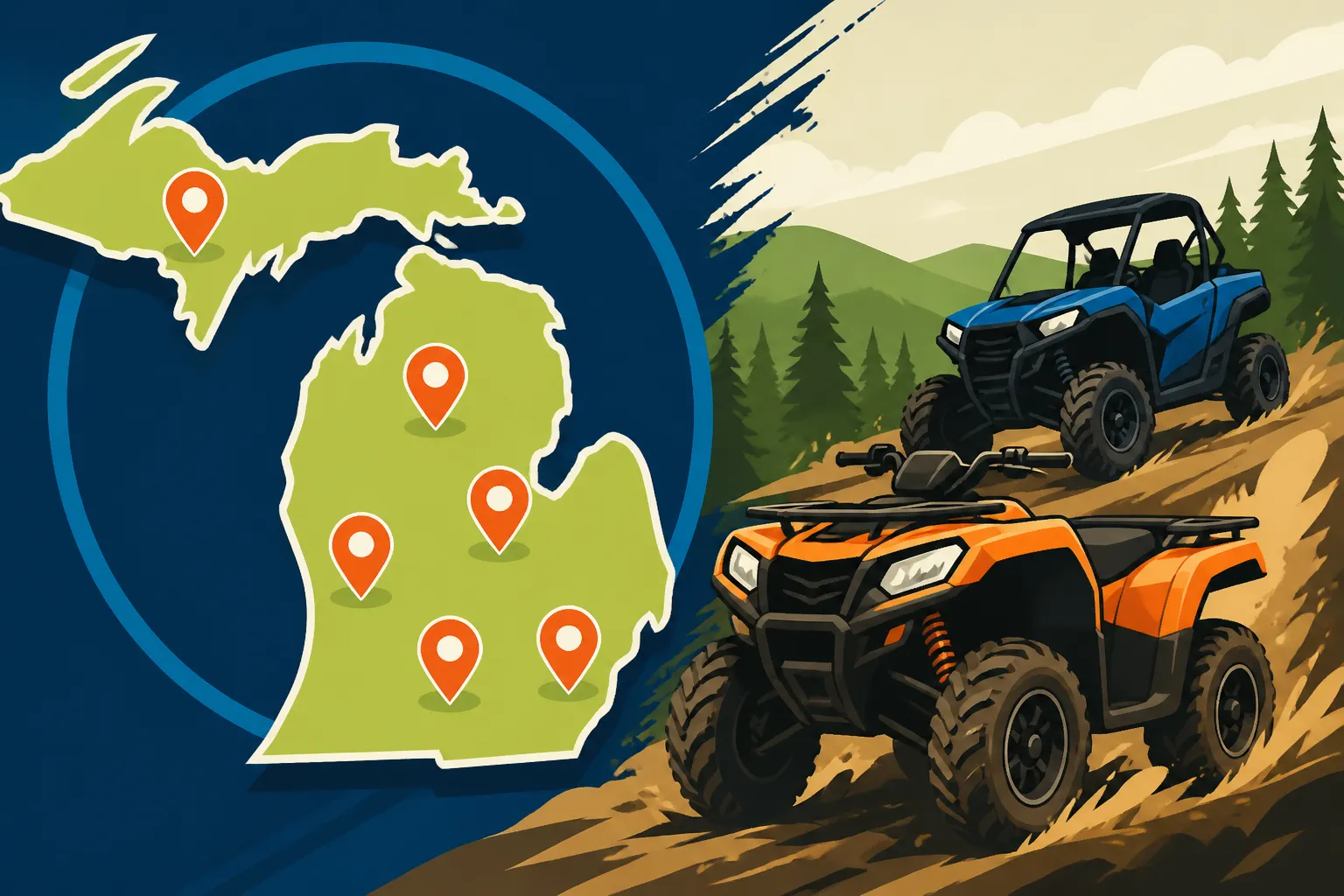
The table below is a planning overview, not a substitute for each site’s current rules. Ownership, available terrain, permitted vehicles, access requirements, and operating details can differ. Confirm those details directly with the manager before you travel.
| Destination | General location | What riders may look for | Important planning point |
|---|---|---|---|
| Black Lake ORV Scramble Area | Near Black Lake and Onaway | A designated northern Michigan riding area with varied ORV terrain | Check current access, permitted machines, and route conditions |
| The Mounds ORV Area | Mount Morris area near Flint | A developed riding destination with a mix of marked riding opportunities | Confirm the managing agency’s rules and current area status |
| St. Helen Motorsport Area | St. Helen in Roscommon County | A northern Lower Peninsula destination for off-road riding | Review area boundaries, machine rules, and any posted closures |
| Silver Lake State Park ORV Area | Near Mears on Lake Michigan | Sand-dune riding in a distinctive coastal setting | Prepare for dune-specific requirements and changing sand conditions |
| Holly Oaks ORV Park | Near Holly in Oakland County | A managed park with varied, purpose-built off-road terrain | Verify park access rules and what vehicle types are allowed |
| Bundy Hill Offroad Park | Near Jerome in southern Michigan | A privately operated off-road venue | Follow the operator’s admission, safety, and vehicle requirements |
Black Lake ORV Scramble Area
Black Lake is a northern Michigan option for riders looking for a designated ORV area rather than a casual roadside place to practice. Its location makes it a natural stop for riders who are already planning a trip around Cheboygan County, Onaway, or the Black Lake region. As with any ORV destination, the exact character of the ride depends on the routes open when you arrive and the condition of the ground.
Do not treat an area name as permission to ride wherever the surrounding landscape looks inviting. Keep to routes and spaces that are officially open, and check for posted boundaries before unloading. Riders who are unfamiliar with the site should spend a few minutes reviewing the map and signs at the entrance or staging area before moving into the riding zone.
The practical approach is to arrive with a plan but remain flexible. If you discover that a preferred route is closed or too difficult for someone in the group, choose another open option rather than trying to find an unofficial bypass. For an introduction to the kind of rating information that can help you judge whether a route fits your group, read [Michigan ORV Trail Difficulty Ratings].
The Mounds ORV Area
The Mounds is a familiar name among riders near Flint and Genesee County, and its location can make it a convenient choice for people who do not want to drive deep into northern Michigan. It offers a different trip profile from a remote trail system: you can plan around a designated riding destination, check the site’s rules in advance, and focus the outing on the terrain available there.
Convenience should not be mistaken for simplicity. A developed ORV area can still have changing conditions, difficult sections, vehicle restrictions, and rules that differ from nearby roads or trails. If your group includes both ATVs and UTVs, find out whether all planned machines can use the same parts of the area. A route that suits a narrow quad might not be suitable for a wide side-by-side.
For a first visit, keep the day’s goal modest. Spend time learning the layout, identify a comfortable stopping point, and avoid following another rider onto a feature simply because they made it look easy. Their machine, tires, experience, and line may be very different from yours. Check current access and park information through the relevant manager before setting a departure time.
St. Helen Motorsport Area
St. Helen is a well-known northern Lower Peninsula riding destination. It can work well for a group that wants a designated place to ride while staying within reach of nearby lodging, fuel, and other trip necessities. The area is also a useful reminder that “scramble” does not describe one single type of terrain: what you encounter depends on the designated riding sections and the conditions on the day.
Plan your route choices around the machines in your group. A rider on a narrow ATV may be able to use more confined sections than a driver in a wider UTV. If the group splits by machine or skill level, agree on a meeting place and a check-in plan beforehand. Cell coverage can be inconsistent in rural riding areas, so do not rely on a phone call as your only way to reconnect.
First-time visitors should take the time to locate staging, parking, and access points before unloading. That small bit of preparation can prevent an avoidable headache later, especially if the trailhead or staging lot is busy. Review [Michigan ORV Trailhead Parking Rules] before you go, and keep trailers and tow vehicles in the spaces intended for them.
Silver Lake State Park ORV Area
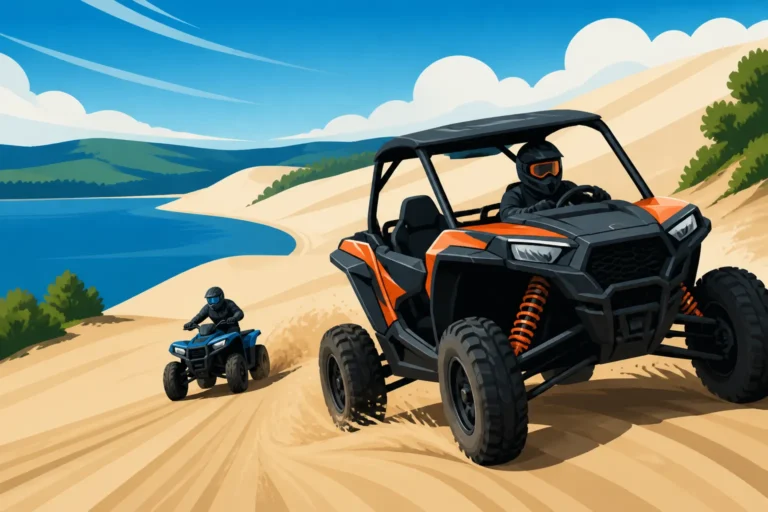
Silver Lake offers a very different experience from a wooded trail or a conventional obstacle area. Riding takes place in a sand-dune landscape near Lake Michigan, where visibility, traction, and elevation can change quickly. Soft sand asks more of a machine and driver than firm ground, and a slope that seems manageable from a distance can feel very different once you begin climbing it.
Dune riding requires preparation beyond simply airing down tires or following another vehicle’s tracks. Learn the area’s entry requirements, equipment rules, boundaries, and safety procedures before you arrive. The park’s rules may be specific to this location, and they should not be assumed to match those at a trail network or private park elsewhere in Michigan.
Keep a generous following distance in sandy terrain. A vehicle ahead can throw up dust, hide a sudden stop, or block your view of a crest. Avoid crossing the path of other riders, and do not stop in a spot where approaching drivers cannot see you. If you are new to dune riding, choose a conservative line and give yourself permission to turn around rather than forcing a climb.
Holly Oaks ORV Park
Holly Oaks, near Holly in Oakland County, is a managed off-road park with terrain that can appeal to drivers looking for a more varied, purpose-built experience. Its location also makes it a possible destination for riders in southeast Michigan who want an outing without a long drive north. Because the park is managed separately from state trail networks, its access and operating rules need to be checked directly.
A managed park may have a mix of surfaces or riding features, but that does not mean every feature is suitable for every machine. Before using an obstacle, consider ground clearance, wheelbase, turning radius, tire condition, and the driver’s experience. A UTV that is heavy or wide may behave differently from a small ATV when climbing, descending, or maneuvering on uneven ground.
If your group has a range of experience, agree that no one needs to attempt every feature. A more experienced driver can wait at a safe location while others choose a suitable route, rather than encouraging a newer rider to follow them into a section that feels uncomfortable. Check the park’s own information for current rules, vehicle eligibility, and any required equipment before leaving home.
Bundy Hill Offroad Park
Bundy Hill is a privately operated off-road destination in southern Michigan. Private parks can be appealing because their terrain and access are managed by an operator, but the rules are specific to that site. Admission, vehicle eligibility, riding areas, safety procedures, and operating details may differ from a public ORV area, so confirm them with the park before you make the trip.
Read the operator’s requirements carefully, particularly if your group is bringing a larger side-by-side, a modified machine, or a vehicle with a passenger configuration that may need special approval. Do not assume that a state permit replaces a park’s own admission process or that a park admission covers riding outside the property. Stay within the boundaries and use only the routes or features open to your machine.
A private park can also be a good setting for a planned skills day, but it is still important to ride within your ability. Walk or inspect a difficult-looking feature only where the park permits it, and never stand where a driver could lose control or where another rider may not see you. Call or check the park’s official information before traveling, especially if weather could affect operations.
Choose the right destination for your group
Compare terrain, access, and management
The best Michigan ORV area is not necessarily the one with the most dramatic terrain. It is the one that fits your machine, the experience level of your riders, the travel time you can manage, and the kind of day you want. A family with young or newer riders may prefer a destination with clearly identified routes and a manageable layout. A group of experienced drivers may want more demanding terrain, provided the area allows their machines and the riders understand the risks.
Ownership and management shape the experience. State-managed destinations, county or local parks, and private facilities may have different access procedures, maps, fees, safety rules, and restrictions. That is why a route description from a riding forum should be treated as a clue, not as the final word. Verify details with the site responsible for the land.
A useful way to compare destinations is to write down the questions that matter to your group: Can every machine ride there? Is the area open on the day you plan to go? Are there suitable options for the least experienced rider? Is there a legal place to park the truck and trailer? What supplies or safety gear does the operator require? Answering those questions in advance usually prevents more problems than trying to pick a destination based only on dramatic photos.
Pick terrain with the least experienced rider in mind
It is tempting to plan a trip around the most confident driver, especially if that person owns the most capable machine. But a group ride is only as comfortable as its least experienced participant. If a newer rider feels pressured to keep up, they may take a line they do not understand, travel too fast, or make a poor choice when the terrain changes.
Ask each rider what they are comfortable attempting before you arrive. “I’ve ridden before” can mean anything from a flat farm lane to a steep, rutted trail. Talk through practical skills such as controlled braking, low-speed turning, riding downhill, and what to do if a machine becomes stuck. The goal is not to test anyone. It is to avoid surprises once helmets are on and the engines are running.
Make it easy for someone to opt out. Agree that riders can stop, turn back, or take a break without having to explain themselves. If a feature looks intimidating, there is no shame in watching another rider assess it from a safe spot or choosing a different route. Riding within your limits is a skill, not a failure.
Consider the machine before choosing the park
Check vehicle limits before you travel, including width, passenger capacity, and any restrictions that may apply to particular types of machines. A full-size UTV can be too wide for a route that works well for a smaller quad. A machine with a long wheelbase may also need more room to turn around than the route offers.
Inspect the machine for the terrain you expect. Confirm that tires are in good condition, brakes work consistently, the throttle returns properly, and steering components are secure. Check fuel range and carry only what you can transport safely. If a machine has recently been modified, test it on familiar ground before taking it to a demanding site.
Different destinations can call for different setup choices. Sand, loose soil, mud, and hard-packed routes do not place the same demands on tires or drivetrain. Do not copy another rider’s setup without understanding why it works for their machine. Follow the vehicle maker’s guidance, use sound judgment, and remember that no modification makes a risky line safe by itself.
Permits, maps, and local rules
Confirm exactly what you need before riding
Permit requirements depend on the riding location, the land manager, and sometimes the type of route or vehicle. A public ORV trail permit requirement may not be the same as a park admission requirement, and a private venue can impose its own rules. Check both the state requirements and the specific destination’s requirements rather than assuming one document covers everything.
Start with [Michigan ORV License and Trail Permit Explained] to understand the difference between the state’s ORV licensing and trail-permit systems. Then check [Permits Michigan Requires at Scramble Areas] for the location-specific questions that can arise at scramble areas. If you are visiting more than one riding area on the same trip, verify the requirements separately for each one.
Keep required paperwork and proof of access where you can retrieve them without unpacking the entire vehicle. Save a copy of the area’s rules and map on your phone, but also consider a paper copy in case the battery dies or service drops. Knowing the boundary and permitted riding zones is part of being prepared, not just a formality.
Use maps as a planning tool, not permission to improvise
An offline map can help with orientation, especially when mobile service is weak. Some riders use onX Offroad to plan routes, save map information, and keep track of where they are. A mapping app is most useful when you load the relevant information before leaving an area with reliable service and understand how to read it before you start riding.
No app should override a sign, closure, or instruction from the land manager. Maps can show routes that are closed, outdated, or outside a riding boundary, and digital location lines may not match the sign you see on the ground. If there is a conflict, stop and confirm what is open rather than guessing.
Before the ride, mark a meet-up location, a turnaround point, and the staging area. Share that plan with everyone in the group. This is especially helpful when riders have different speeds or machines, or when a larger group may spread out along a route. A map can support good group habits, but it cannot replace them.
Look for closures and seasonal changes
Access can change because of weather, maintenance, land-management decisions, or seasonal restrictions. A route that was open on your last visit may not be open next time. Sand, heavy rain, thawing ground, or maintenance work can also make a route temporarily unsuitable even when it is technically available.
Check for current notices close to your departure date, then check again when you arrive. The destination’s official page or posted signs are more reliable than an old social media post. [Michigan ORV Trail Closures and Seasonal Dates] is a helpful place to start when you are planning a trip around seasonal access.
Respect closed gates and barriers. Do not ride around them, cut a new route, or follow tire tracks through a closed area. Closures often protect the land, the riders, or both. Ignoring them can damage terrain and put future access at risk for everyone.
Plan a safe and enjoyable scramble-area day
Prepare the machine and your gear
Start with a basic pre-ride inspection. Check tires, lug nuts, brakes, steering, lights, throttle operation, fuel, and any fluid leaks. Secure loose cargo so it cannot shift on an uneven route. If you are towing the machine, inspect the trailer, tie-downs, hitch connection, and tire condition before leaving home.
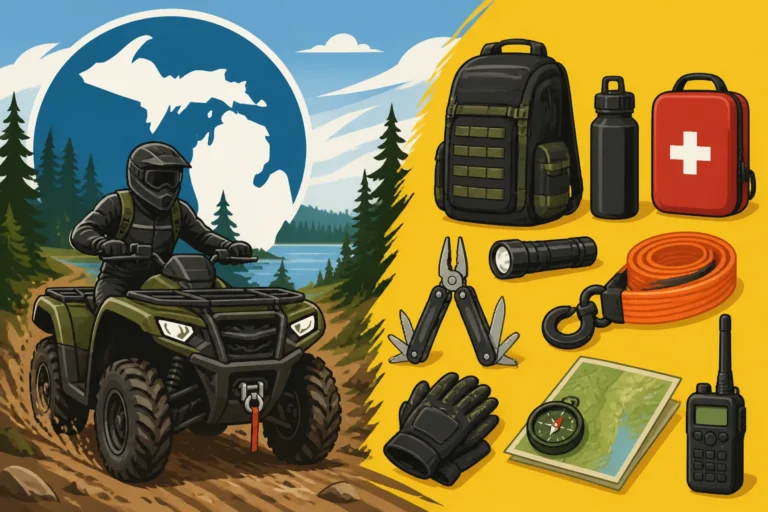
Pack for the riding area rather than assuming you will only be a few minutes from the truck. Bring water, weather-appropriate layers, eye protection, gloves, and a first-aid kit. A phone, charger or power bank, and a basic tool kit can help, but they are not substitutes for telling someone where you are going and when you expect to return.
Your list will change with the season and destination. Sand riding can mean more dust and sun exposure, while a cold-weather outing may require extra insulation and a plan for wet clothing. For a fuller checklist, see [Packing List for a Full Trail Day]. Keep essentials in a secure, accessible place instead of burying them beneath equipment you will not need until the ride is over.
Set expectations before leaving the staging area
Gather everyone before starting the ride. Confirm the route, the order of riders, the planned pace, and how the group will respond if someone stops or falls behind. Establish a simple rule: if a rider cannot see the person behind them for a while, they slow or stop at a safe place rather than continuing indefinitely.
Agree on how to handle a breakdown, a stuck machine, or a rider who wants to turn back. Keep the group together where possible, but do not crowd a narrow route or line up too closely behind a machine climbing a hill. A vehicle can roll back, slide sideways, or lose traction unexpectedly.
Make sure each person knows where the staging area is and how to get help. If the group separates, riders should know the agreed meeting point and should not leave the riding area alone unless the plan calls for it. A little coordination at the start can prevent a stressful search later.
Ride with other people in mind
Good manners matter in a shared riding area. Slow down when approaching people, staging areas, intersections, or places where visibility is limited. Give other riders room, avoid spraying dirt or sand at people, and do not block a route while stopping for a conversation or repair.
Stay on established routes and use only the features open to your vehicle. Cutting corners may seem harmless, but repeated shortcuts widen paths and damage vegetation. The same goes for spinning tires in a sensitive area or making new lines around a difficult section. Follow posted directions and leave the route in the condition you would want to find it.
For a practical refresher on riding around other users, read [ORV Trail Etiquette on Shared Routes]. Courtesy is not just about avoiding arguments. It helps keep the area safer and more welcoming for families, beginners, and riders who share the same public or managed land.
Common first-visit mistakes to avoid
Assuming every destination uses the same rules
A frequent mistake is treating all Michigan riding areas as if they were one connected system. Riders may assume that a permit, access sticker, or vehicle setup accepted at one location automatically applies at another. That can lead to a wasted drive, a denied entry, or a ticket.
Make a short destination checklist for each stop: who manages the land, what the site requires, which machines are allowed, what areas are open, and where to park. If the operator has specific safety or equipment rules, read them before you load the trailer. A few minutes of checking is easier than sorting out a problem at the entrance.
If information seems unclear, contact the manager before traveling. Ask direct questions about your machine type and intended riding area. A broad question such as “Can I ride here?” may not get the detail you need; explain whether you are bringing an ATV or UTV, whether it carries passengers, and what kind of access you are planning.
Following another rider onto a difficult feature
It is easy to assume a route is safe because another driver just completed it. That driver may have different tires, a lighter machine, more experience, or a clear view of the route that you do not have. They may also have been lucky.
Pause before attempting a hill, rut, or obstacle. Look for a safe place to stop, assess the surface, and consider how you will turn around if the route is harder than it appears. Do not enter a feature if another vehicle is directly below or above you in a way that leaves no room to recover.
If you are riding with someone who wants to attempt something beyond their comfort level, do not pressure them. Offer to wait, take another route, or return later. A group that respects individual limits is usually more relaxed and safer than one that treats every obstacle as a challenge to prove something.
Arriving without a parking and recovery plan
An ORV trip can go sideways before the ride begins if the trailer does not fit, the staging lot is full, or the group is unsure where to meet. Verify parking arrangements, especially if you are towing a long trailer or traveling on a busy weekend. Do not block entrances, emergency access, or the space needed by other vehicles.
Think through basic recovery needs without assuming that another rider will solve every problem. Carry appropriate recovery equipment only if you know how to use it safely, and never attach a recovery strap to a point not designed for towing. Keep people clear of tensioned straps and moving vehicles.
Finally, set a turnaround time. It is easy to lose track of daylight when the group is having fun, particularly in unfamiliar terrain. Leave enough time to return to the staging area, load carefully, and get home without rushing. Good planning lets you enjoy the ride rather than spending the last hour worried about logistics.
A simple planning checklist
Before traveling to any of the six destinations, use this sequence:
- Confirm the site’s current access information with its land manager or operator.
- Verify rules for your specific ATV or UTV, including width and passenger requirements.
- Check permits, admission, safety requirements, and any site-specific equipment rules.
- Review the map and mark the staging area, meeting point, and intended riding zone.
- Check for closures, weather concerns, and conditions that may affect the terrain.
- Inspect the machine and trailer, and pack water, protective gear, tools, and first aid supplies.
- Brief the group on pace, route choices, separation procedures, and when to turn back.
- Follow posted signs, stay within open boundaries, and leave the area as you found it.
Michigan’s scramble-style destinations offer very different days out: dunes at Silver Lake, designated ORV-area riding at places such as Black Lake and St. Helen, and managed or privately operated park experiences at sites such as Holly Oaks and Bundy Hill. Choosing well comes down to checking the details, matching the terrain to your group, and treating every site’s rules as its own.
Disclaimer
This article is for general informational purposes only and does not constitute professional advice. Laws, prices and regulations vary by location and change over time. Consult a qualified professional for guidance on your specific situation.