Black Lake Route Riding Conditions
Black Lake riding conditions can change quickly with rain, frost, traffic, and maintenance, so a route that felt easy on a dry afternoon may be slick, rutted, or dusty the next day. This guide explains what riders can generally expect around Black Lake, how to prepare for changing surfaces, and how to check access before unloading your ATV or UTV.
What Black Lake Route Riding Is Like
Expect a mix of route surfaces
The Black Lake area in northern Michigan has a network of ORV routes and connecting roads rather than one uniform trail surface. Depending on your planned loop, you may encounter gravel, dirt, packed forest-road surfaces, loose material, and short stretches that feel rougher after weather or repeated traffic. Even within one ride, the surface can change enough that a comfortable pace on one section may be too fast on the next.
That variety is part of the appeal, but it makes assumptions risky. A smooth, dry road can turn uneven where vehicles have worn grooves, while a shaded stretch may stay damp after nearby open ground has dried. Riders planning a first trip can compare the area with [Black Lake and Indian River ORV Routes] and look at [Indian River Route Trail Access] when deciding how to build a loop.
Treat the route as a changing public riding environment, not a groomed course with predictable conditions. A wider UTV may feel steady on open gravel but need more room to maneuver around washouts, soft shoulders, or oncoming traffic. On an ATV, loose gravel can move under the tires during turns and braking, so leave extra space and avoid sudden steering inputs.
Routes and trails are not interchangeable
The word “route” matters. Michigan ORV routes may include roads designated for ORV use, while trails can have different surfaces, widths, and access rules. A road that looks suitable for an ATV or side-by-side is not automatically open to ORVs. Follow the posted signs and route markings, and do not assume that a nearby road or spur is legal just because it connects to a designated route.
Before heading out, review [Michigan ORV Trail Maps and What the Signs Mean] and [Michigan ORV Trail Widths Explained]. Maps and signs help you distinguish designated access from nearby roads that may be closed or restricted. Keep in mind that a map app is a navigation aid, not permission to ride wherever a line appears on the screen.
If your loop connects with public roads, check the rules for the specific road and community rather than relying on what another rider did. Local ordinances and posted restrictions can affect where ORVs may travel. The safest habit is to confirm the route on an official map, watch for signs at junctions, and turn around if the designation is unclear.
How Weather Changes Riding Conditions
Dry weather, dust, and loose gravel
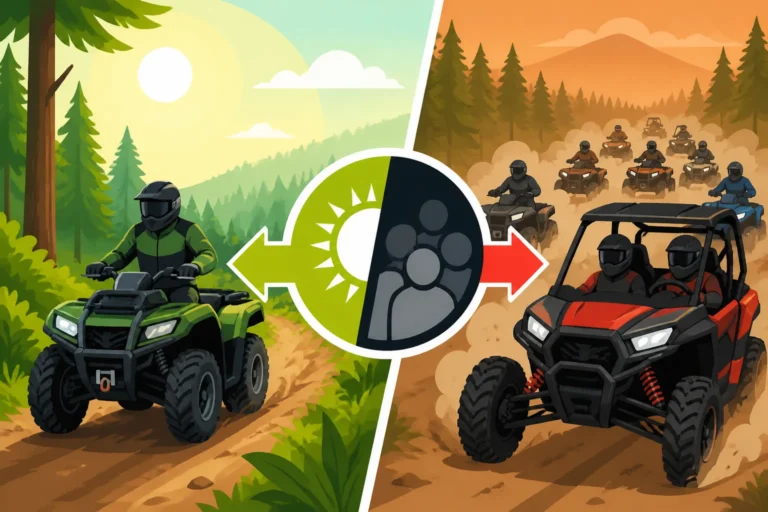
During dry stretches, dust can become a major part of the ride, especially when several machines are traveling close together. Dust may hide small ruts, loose stones, or a change in surface ahead. It can also reduce visibility for riders behind you and make it harder to see an approaching vehicle around a bend.
Leave a generous gap between machines and slow down when visibility drops. If you are riding in a group, agree on a pace that lets the last rider travel without being swallowed by the dust cloud. Goggles and a dust covering can make the ride more comfortable, but they do not replace spacing and a controlled speed.
Loose gravel deserves particular care when cornering or braking. Reduce speed before a turn instead of braking hard while steering, and be cautious near the road edge, where gravel can be deeper or less compacted. A dry route may feel easy at first, but repeated traffic can shift the top layer and make some sections less predictable.
Rain, soft ground, and spring thaw
Rain can change traction quickly. Packed gravel may become slick, dirt may soften, and low areas can hold water after higher ground has dried. Deep puddles are especially difficult to judge: they may be shallow, or they may conceal a rut, a soft edge, or a hole. If you cannot see the bottom or assess the ground safely, do not charge through it.
Wet conditions also increase the chance of rutting and trail damage. Avoid spinning the tires, making repeated attempts through a soft section, or riding around a puddle onto vegetation. Those choices can widen the damaged area and create hazards for the next rider. Guidance in [ORV Trails After Heavy Rain] is useful when deciding whether to postpone a ride or choose a firmer route.
Spring thaw and prolonged wet weather can make some unpaved surfaces much more vulnerable than they appear. Check for official closures before traveling, and respect barriers even if the route seems passable. [Michigan ORV Trail Closures and Seasonal Dates] is a helpful starting point for understanding why access can change; confirm the specific route status before departure.
| Condition | What you may notice | A sensible response |
|---|---|---|
| Dry and dusty | Reduced visibility, loose gravel, dust between machines | Increase following distance and slow down when sightlines are poor |
| Recently rained on | Slick patches, standing water, soft shoulders | Avoid hidden puddles and turn around if the surface feels unstable |
| Spring thaw or prolonged wet weather | Deepening ruts, muddy low areas, possible closures | Check official notices and avoid damaging soft ground |
| After a freeze-thaw cycle | Uneven surfaces, firm crust over softer ground | Reduce speed and watch for sudden changes in traction |
| Busy weekend conditions | More dust, oncoming riders, and traffic at junctions | Stay alert, ride single file where appropriate, and yield carefully |
Planning a Safer Ride Around Black Lake
Check the route and access before you leave
A little planning can prevent the frustrating experience of towing a machine to a trailhead only to discover a closure, a confusing junction, or an unsuitable loop. Check a current official map and notices close to your ride date. onX Offroad can be useful for viewing route lines and preparing offline navigation, especially where phone reception is unreliable, but compare its information with official designations and signs on the ground.
Save the intended route before leaving a reliable service area. Mark your starting point, identify a few reasonable turnaround options, and let someone know where you plan to ride and when you expect to return. This matters even on a familiar loop: a missed turn, a mechanical issue, or a slower-than-expected surface can stretch a short outing.
Also confirm the machine’s size and the route’s restrictions before setting out. Do not assume that every connector shown on a map accommodates every machine. Review the permit and access requirements in [Michigan ORV License and Trail Permit Explained], and check for posted restrictions along the way. Carrying a map as a backup is a good idea even if you normally navigate by phone.
Prepare for the day, not just the forecast
A forecast gives you a broad idea of the day, but it cannot tell you exactly how a shaded section or low spot will ride. Pack for changing conditions: water, weather-appropriate layers, basic repair supplies, a charged phone or navigation device, and a way to contact help if your machine becomes disabled. UTV riders should also secure loose gear so it cannot shift or interfere with controls.
Fuel planning deserves attention, too. Do not assume that a convenient stop will be open, close to your route, or easy to reach without detouring onto roads where ORVs are not permitted. Check the loop length against your machine’s practical range and review [Fuel Stops Along Michigan ORV Trails] as part of your planning. Leave room for slow sections, wrong turns, or a return trip that takes longer than expected.
Before rolling out, inspect tires, brakes, lights, steering, and any straps or cargo. After a rough or muddy stretch, pause somewhere safe and check for packed debris or anything that has shifted. A short inspection can catch a problem before it turns into a difficult roadside repair.
Riding Etiquette and On-Route Decisions
Share the route thoughtfully
Black Lake area routes can include other ORV riders, local traffic, and people using nearby roads for everyday travel. Ride predictably, keep a controlled speed, and be ready for another vehicle around a bend or over a rise. At intersections, slow down enough to read the signs and make a deliberate turn rather than following another machine automatically.
Group rides need extra spacing and clear communication. Leave enough room for dust to settle, make sure the rider behind you knows when the group changes direction, and choose regrouping spots that do not block the route. [Trail Etiquette on Shared Routes] offers useful reminders for keeping shared riding areas comfortable for everyone.
Be considerate of residents and other visitors. Avoid unnecessary revving, litter, and riding outside designated areas. If a route is muddy, do not cut around the damaged section through brush or private property. A temporary delay or turnaround is frustrating, but it is better than making the route worse or creating an access problem.
Know when to slow down or turn around
The most useful riding skill is recognizing when conditions have moved beyond your comfort level. A machine may be capable of crossing a muddy patch, but that does not mean forcing through is wise. If the surface is breaking apart, the route is becoming deeply rutted, or visibility is poor, stop in a safe place and reassess.
Turn around when you encounter an official closure, an unclear junction, a deteriorating surface, or a hazard you cannot evaluate confidently. Avoid riding around barriers or treating someone else’s tracks as proof that access is allowed. If you come across a blocked route or damage, note the location and report it through the appropriate official channel rather than trying to clear or bypass it yourself.
A good Black Lake ride is not measured by how much ground you cover. It is one where the route, weather, and machine all match the riders’ experience and preparation. Check the access, adjust your pace to the surface, and be willing to change the plan when conditions call for it.
Disclaimer
This article is for general informational purposes only and does not constitute professional advice. Laws, prices and regulations vary by location and change over time. Consult a qualified professional for guidance on your specific situation.