Best Michigan ORV Trails for Side-by-Sides
A side-by-side can feel roomy on a two-track and suddenly become a poor fit when a route narrows, gets rutted, or is signed for smaller machines. Michigan offers everything from wooded routes to sandy riding areas, but not every ORV trail allows every vehicle. This guide explains where to look, how to match a route to your machine, and what to check before you unload.
How to choose a Michigan ORV trail for a side-by-side
Start with the machine, not the destination
“Side-by-side” covers a wide range of vehicles. A compact two-seat UTV, a four-seat family machine, and a wide sport model may have very different dimensions and turning needs. Before choosing a destination, check your vehicle’s overall width, length, wheelbase, ground clearance, and any manufacturer restrictions. Width matters especially: some Michigan trails are designated for machines no wider than 50 inches, and a larger side-by-side cannot use them just because it can physically squeeze between the trees.
A bigger vehicle may also need more room to turn around or pass another machine. A trail that looks manageable on a map can feel tight when the shoulders are soft or a fallen branch blocks part of the tread. If your UTV is long or wide, a route with roomier surfaces may be more comfortable than a narrow, twisting trail, even if both are technically suitable.
Before loading up, compare your machine’s dimensions with the route designation on the latest official map and posted signs. A machine’s advertised width may not tell the whole story if it has added accessories, wider tires, or other modifications. If you are shopping for your first machine, [Michigan Trail Widths and 64-Inch Machines] can help you think through the practical difference between trail widths.
Understand trails, routes, and roads
Michigan ORV maps distinguish among different types of riding opportunities. A narrow trail, a wider route, and an open road segment may have different vehicle allowances and riding conditions. The word “route” should not be treated as a blanket guarantee that every side-by-side is allowed. Read the map legend, check the listed width or vehicle category, and confirm the signs at the entrance.
A designated road route may feel less like a winding woodland trail and more like a gravel-road connection between riding areas. That can be a good match for a larger UTV, but the ride may involve traffic, dust, washboard, or stretches where you need to be especially alert. A forest trail may feel more enclosed and scenic, but it can also be more demanding for a wide machine.
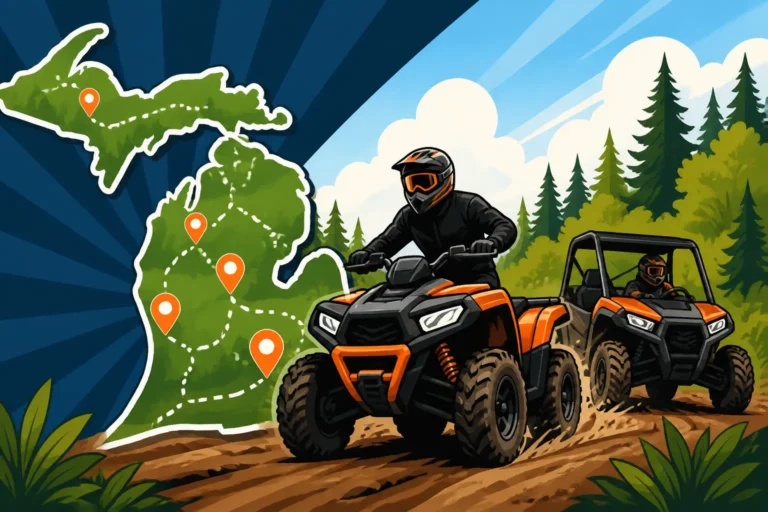
Look at the whole trip, not just the name of the destination. A group may plan to ride a route, stop for fuel, and connect to another area—only to discover that the connecting segment has a different designation. Use the official map to plan each leg, and consider tools such as Michigan ORV Trail Maps and What the Signs Mean when you are learning how map markings relate to the signs you will see on the ground.
Match the terrain to your group’s experience
A route that is fun for a confident driver can be stressful for someone who is new to a side-by-side. Tight turns, loose sand, mud, steep grades, rocks, and rough washouts all add difficulty in different ways. A passenger may also experience roughness differently from the driver, particularly in a long-wheelbase machine that bounces through uneven sections.
Think about the least experienced person in your group, not just the most adventurous one. If one driver is nervous about narrow trails or steep terrain, choose a route with easier turnarounds and room to take a break. A family group may prefer a predictable route and a short first ride over a full-day plan with several unknown connections.
Weather changes the character of a route. A stretch that is comfortable when dry may become slick after rain, while loose sand can be tiring in hot weather. Before heading out, check for closures and recent conditions, and be ready to change plans if the route looks damaged or unsuitable. [Michigan ORV Trail Difficulty Ratings] is a useful companion topic when you are deciding how ambitious to make your ride.
Michigan riding areas to consider for side-by-sides
Drummond Island for a destination ride
Drummond Island is a popular destination for ORV riders, with a mix of wooded riding, rocky sections, and route connections. Its character can make the trip feel like more than a quick afternoon ride: you are planning a whole outing, with travel, lodging or camping, and the practical details of getting your machine to the island.
Conditions can vary considerably across the riding area. Limestone and rocky surfaces may become more challenging when wet, while uneven sections can be tiring in a full-size machine. A wide side-by-side needs particular care on narrow stretches and when meeting oncoming riders. Don’t assume every track visible on a navigation app is open to your vehicle or legal to ride; use the designated route information and follow posted restrictions.
Plan a conservative first day if you are unfamiliar with the area. Get oriented, note where your group can safely stop, and make sure everyone understands the route before separating or taking alternate lines. The article [Drummond Island ATV Trail Mileage] can help with destination planning, while [Drummond Island Limestone Trails After Rain] covers why surface conditions deserve extra attention.
St. Helen for a northern Lower Peninsula base
St. Helen is a familiar base for riders exploring the northern Lower Peninsula. Its local riding opportunities can work well for a weekend plan, particularly if you want to combine ORV riding with nearby services and a place to return to after the day’s ride. As with any destination, the best fit depends on your specific machine and the sections you intend to ride, not simply the general reputation of the area.
A side-by-side driver should verify which segments allow the vehicle’s width. Route names, nearby roads, and trail connections can create the impression of one continuous network, but designations may change from one segment to another. Carry a map and check signs at junctions instead of following another group without knowing where its route goes.
St. Helen can be a reasonable choice for a mixed-experience group if you plan a route that allows for breaks and a straightforward return. Avoid overloading the day with unfamiliar connections, especially if you have passengers or are managing several vehicles. For more local planning context, see St. Helen ORV Trails in Michigan and [St. Helen as an ATV Base Town].
Gladwin and Mio for route-based exploring
The Gladwin area offers a different kind of ride from a tightly enclosed trail: riders may use a combination of designated routes and connecting segments to build an outing. That can suit a side-by-side group that enjoys exploring, but it also requires careful navigation. A route that appears convenient on a broad map may lead to a turn, road crossing, or segment with a different vehicle restriction.
The Mio area is another place to investigate when planning a northern Lower Peninsula ride. Before committing, determine whether the specific portion you want to use is designated for your UTV. The difference between a trail and a route is not merely a naming detail; it can affect whether a wide machine is permitted. Confirm access at each connection, particularly when crossing between mapped areas.
For either destination, plan around daylight, fuel range, and the pace of the slowest driver in your group. A scenic ride can become frustrating if the group has to retrace a long stretch after missing a junction. [Gladwin Route Access Points] and [Mio Trail vs Mio Route Width] are useful starting points for narrowing down your route plan.
| Riding area | What may appeal to side-by-side riders | What to check before riding |
|---|---|---|
| Drummond Island | Destination feel, wooded riding, varied surfaces | Width designations, rocky or wet conditions, route connections |
| St. Helen | A northern Lower Peninsula base for a day or weekend | Vehicle allowances on each segment, current signs and closures |
| Gladwin area | Route-based exploring and connected riding opportunities | Whether each chosen segment allows your machine |
| Mio area | A way to plan a ride around mapped trails and routes | Distinction between trail and route, width restrictions |
| Silver Lake | Sand riding and a distinct dune experience | Vehicle requirements, permits, operating rules, and area conditions |
| Holly Oaks | A managed ORV park experience near southeastern Michigan | Park access rules, vehicle fit, operating schedule and conditions |
Pick a riding experience that fits your side-by-side
Forest routes and wooded trails
A wooded ride is often what people picture when they think of Michigan ORV riding: shade, sandy or earthy surfaces, changing light, and the sound of the machine echoing through the trees. These routes can be especially enjoyable in a side-by-side because passengers can share the outing, but the enclosed setting means there may be little room to move aside or turn around.
Tree cover can also make it harder to judge a trail’s width from a distance. A bend may hide a soft shoulder or a narrow spot, and an oncoming vehicle can appear quickly. Keep a controlled pace, stay on the designated surface, and use extra care at blind corners. If you are riding with children or first-time passengers, explain that bumps, dust, and sudden stops are part of the experience.
On a forest ride, comfort depends on more than suspension. Bring water, eye protection, and a way to navigate if cell service is poor. Plan stops at safe pull-offs rather than stopping in the middle of a narrow section. Keep the group together and agree on what to do if a vehicle gets separated. A calm, well-paced ride is often more rewarding than trying to cover as much ground as possible.
Sand and dunes
Sand can make a side-by-side ride feel completely different from a wooded trail. The surface moves under the tires, visibility can be affected by dust, and drivers may need to adjust their technique to avoid abrupt steering or throttle inputs. The Silver Lake area is known for dune riding, but it is a managed riding destination with specific access and operating requirements—not simply an open stretch of beach or sand.
Before bringing a machine, check the area’s current vehicle requirements, permits, safety rules, and posted restrictions. A side-by-side must meet the requirements for the riding area, and passengers need to understand how to stay secured and communicate with the driver. Don’t assume that an ORV license or trail permit automatically covers every type of riding area or every activity.
Sand can also be physically demanding. Heat, glare, and fine dust can wear people down faster than expected, especially on a long day. Carry water, protect your eyes, and leave room between vehicles so dust and sudden stops do not turn into a safety issue. For practical preparation, read [Silver Lake Dune Vehicle Requirements Checklist] and [Getting Stuck in the Dunes at Silver Lake].
ORV parks and managed riding areas
A managed ORV park can be a useful choice for riders who want a defined place to ride without planning a long route through a broad network. Holly Oaks, near southeast Michigan, offers a different setting from a remote forest trail. Riders should still confirm vehicle suitability, access rules, and operating information before traveling; a park’s name or reputation does not replace checking its own requirements.
A park can also be a good place to learn how your side-by-side handles different surfaces, provided you choose terrain that matches your experience. Start with easier sections, give yourself room to observe obstacles, and avoid following another driver onto a feature you have not assessed. Passengers may find repeated bumps tiring, so build in breaks and communicate before tackling rougher terrain.
Managed areas can be busy, particularly on popular days. Be patient in staging areas, leave room for other vehicles, and follow staff directions and posted signs. If you are bringing a new driver, discuss basic hand signals and how the group will regroup after a feature or intersection. For planning, [Holly Oaks ORV Park Terrain and Obstacles] can help you consider what kind of experience to expect.
Plan a legal and practical route
Check the map, signs, and closures
Use the latest official ORV map as your foundation, then verify your route on the ground. Pay attention to the legend and markings that identify vehicle classes, widths, and designated routes. A map may help you plan, but a sign at a junction can alert you to a restriction or closure that changes where you can ride.
Navigation apps can add context, but they are not a substitute for legal access information. onX Offroad can be useful for viewing and organizing route information, especially when you want to plan a trip before leaving home. Cross-check what you see against official maps and posted signs, and do not treat a line on a screen as proof that a road or trail is open to your machine.
Save or carry information in a way that works if you lose cell service. Before the ride, identify your starting point, planned turnaround, fuel options, and a backup route. If conditions or a closure make the planned route unsuitable, turn around rather than improvising onto an unmarked road. [Michigan ORV Trail Closures and Seasonal Dates] offers more context on checking access before a trip.
Permits, stickers, and machine readiness
Michigan ORV riding may require licenses or permits depending on where and how you ride. Requirements can differ by location and vehicle use, so confirm what applies to your planned route and riding area before you leave. Don’t wait until you are at a trailhead to discover that you are missing a required permit or that your chosen area has an additional requirement.
Check that any required sticker is displayed where it can be seen and remains attached. Keep the machine’s paperwork and your personal documents accessible, but protected from rain, mud, and dust. If you are riding with friends, make sure each driver understands their own responsibilities rather than assuming one person’s permit or paperwork covers the whole group.
Do a basic machine check before loading and again at the start of the ride. Look over tires, wheels, brakes, lights, belts, fluids, and steering. Confirm that seat belts work, doors or nets close properly, and the machine’s cargo is secured. For a deeper permit overview, see [Michigan ORV License and Trail Permit Explained].
Road crossings, shared areas, and respectful riding
Some rides involve road crossings or travel on designated road segments. Treat these as distinct from trail riding: slow down, obey signs, watch for traffic, and follow the rules for the specific road and jurisdiction. A county or township ordinance may affect where ORVs can operate, so never assume that a road is open simply because another rider used it.
On shared routes, keep your speed appropriate for visibility, surface, and traffic. Give other riders room, avoid crowding vehicles ahead, and be alert for pedestrians, bicycles, logging trucks, and local traffic. Dust can reduce visibility for everyone, including drivers who are approaching from the opposite direction.
Respect for private property and nearby residents matters just as much as vehicle control. Stay on designated routes, keep noise down near homes and campgrounds, and do not make new paths around muddy or damaged sections. Staying on the marked surface protects the route and helps preserve access for future rides.
Make the trip comfortable and safer
Prepare the group before departure
A group ride is easier when everyone knows the plan. Share the route, meeting point, expected pace, and regroup locations before anyone starts the engine. Agree on what to do if a vehicle stops, takes a wrong turn, or needs to turn back. If the group includes several machines, use a lead driver who knows the route and a trailing driver who can help notice if someone falls behind.
Passengers should understand how to enter and exit safely, keep seat belts fastened, and avoid leaning or reaching outside the vehicle. Children may find a long, bumpy ride tiring even when they are enthusiastic at the start. Schedule breaks before people become uncomfortable, and make sure passengers know they can speak up if they need to stop.
Bring water, basic first-aid supplies, weather-appropriate layers, and a way to contact help. Keep essential items secured so they cannot shift during rough sections. A small repair kit suited to your machine and a plan for a disabled vehicle can prevent a minor problem from becoming a long, stressful day.
Ride at a pace that leaves room for surprises
A side-by-side can feel stable and capable, which can tempt drivers to go faster than the conditions justify. But ruts, loose sand, hidden rocks, washed-out edges, and unexpected oncoming traffic can change the situation in seconds. Ride slowly enough to stop within the distance you can see, especially around corners and near trail junctions.
Leave space between vehicles. If the lead driver brakes suddenly, the following driver needs time to respond without swerving into a soft shoulder. In dusty conditions, increase the gap further so you can see clearly. Avoid stopping in a narrow section unless there is an immediate safety need; when you do stop, choose a safe place where others can pass.
Take turns and obstacles deliberately. If you are unsure whether your machine can clear a feature, pause and assess it rather than relying on momentum. Keep hands and feet inside the vehicle, use the restraints designed for the machine, and do not carry passengers beyond its intended seating capacity. A controlled ride is more enjoyable than recovering from a preventable mistake.
Leave the trail in good condition
Michigan’s riding areas depend on riders using them responsibly. Stay on marked routes, avoid widening the trail, and do not ride around muddy spots in a way that damages vegetation or creates new tracks. If an area is closed, respect the closure even if the route looks passable. A short detour may seem harmless but can damage sensitive ground or jeopardize access.
Pack out what you bring in, including food wrappers, broken straps, and small repair parts. Keep noise considerate near homes and campgrounds, and avoid revving unnecessarily at staging areas. If you encounter trail damage, a hazard, or a confusing sign, note the location and report it through the appropriate channel rather than trying to fix or reroute the trail yourself.
Good trail etiquette also includes patience. Let faster groups pass where it is safe, give newcomers room to learn, and offer help if another rider has a genuine problem. A side-by-side ride is not just about reaching a destination; it is also about sharing a public recreation space with people who may be traveling at different speeds and with different levels of experience.
Build a side-by-side trip that works for your group
Plan distance and timing realistically
It is easy to underestimate how long a trail day will take. Stops, junctions, changing conditions, passenger breaks, and small mechanical issues all add time. Instead of planning the longest possible loop, choose a route with an easy way to shorten the outing if the group is tired or conditions are worse than expected.
Fuel planning deserves attention, especially when riding away from towns or services. Estimate your machine’s range conservatively and consider how terrain, load, passenger weight, and driving style may affect fuel use. Do not assume that a fuel stop shown on a general map is available to ORVs or open when you arrive. Confirm the plan before setting out.
If you are traveling from another part of Michigan, build in time for loading, unloading, and securing the machine. A rushed departure can lead to missed equipment or paperwork. Pack the night before, check the trailer and tie-downs, and make sure the group knows where to meet. [Fuel Stops Along Michigan ORV Trails] and [Michigan ORV Staging Areas and Parking] can help with the logistics.
Choose lodging and staging with the ride in mind
A good base makes an ORV weekend easier. Consider the distance between lodging, staging areas, fuel, food, and the route you intend to ride. A place that looks close on a map may require a long drive by trailer, while a campground near a trailhead may have its own rules about parking, noise, and machine access.
Confirm where you are allowed to park and whether trailers can remain at the staging area. Keep loading and unloading orderly so you do not block other riders. If you are staying at a campground, check whether machines may be operated on internal roads or whether you need to trailer to a designated access point.
For a multi-day outing, avoid repeating a route plan without checking conditions each morning. Rain, closures, fatigue, and mechanical issues can change what makes sense. Keep one alternate activity in mind—such as a shorter ride or a nearby town stop—so the trip still feels worthwhile if the planned route is not a good fit.
Use navigation tools as support, not permission
Digital maps can make it easier to understand where you are and prepare for junctions, but they can also create false confidence if you rely on them without checking designations. onX Offroad may help you review and organize route information, while an official map and signs remain important for confirming where your machine is allowed. Download or save what you need before leaving an area with dependable service.
Before riding, zoom in on the details that matter: width restrictions, route connections, road crossings, trailheads, and possible turnaround points. A broad overview is helpful for choosing a destination, but detailed planning is what prevents a wrong turn onto a route that is not suitable for a wide side-by-side.
Use navigation to support good decisions, not to override them. If a route looks closed, unsigned, or inconsistent with the official information, stop and reassess. Ask a local land manager or another appropriate source if you need clarification. The safest plan is the one that respects access rules and leaves enough flexibility to adapt.
Disclaimer
This article is for general informational purposes only and does not constitute professional advice. Laws, prices and regulations vary by location and change over time. Consult a qualified professional for guidance on your specific situation.