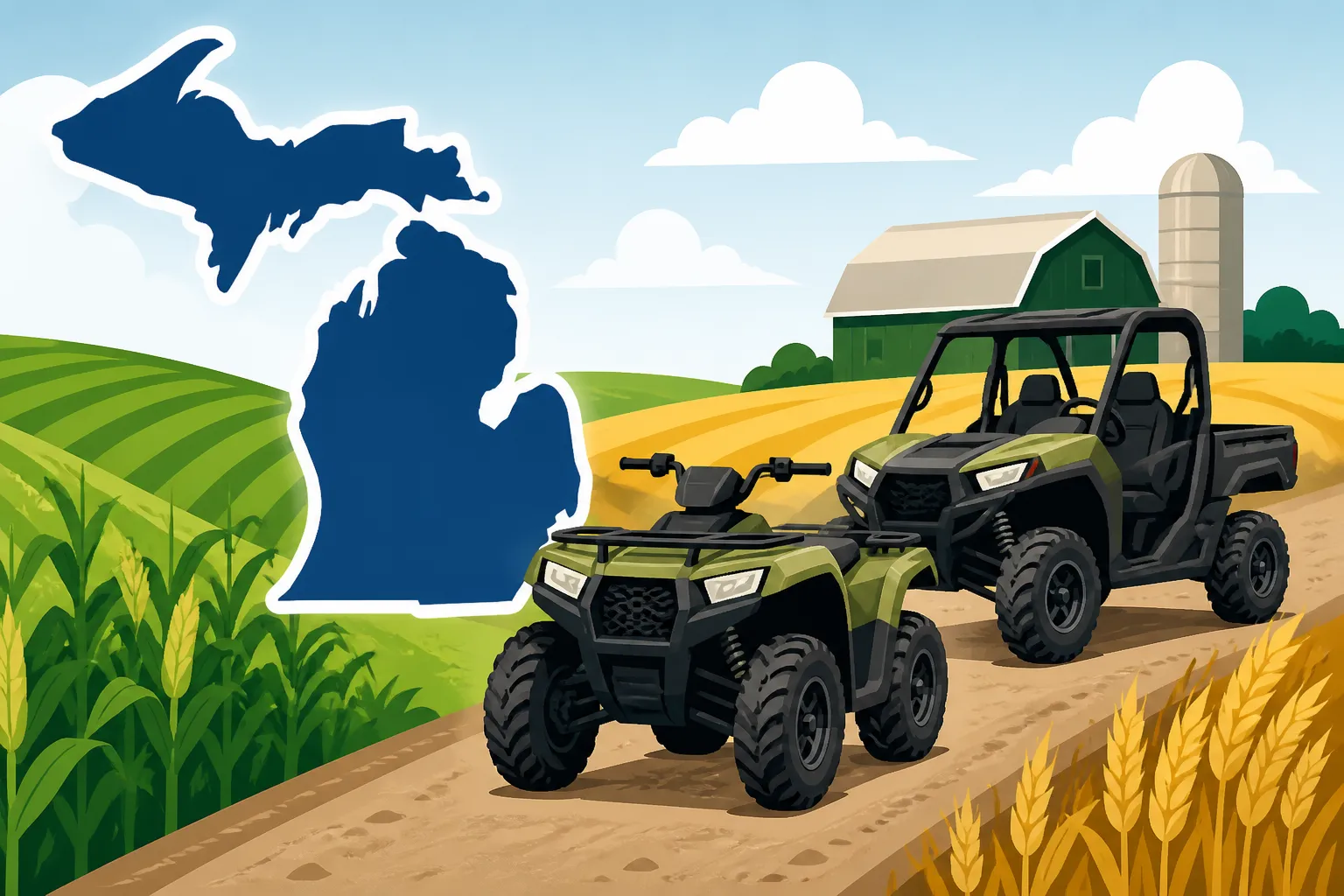
Michigan Agricultural ORV Road Exemptions
As a Michigan farmer, you've likely stared at your trusty ATV or UTV and wondered, "Can I actually take this on the road to get to that back forty, or to haul feed across the street, without running afoul of the law?" The confusion around using off-road vehicles (ORVs) for agricultural tasks on public roads is a very real frustration for many, often leading to uncertainty or even unintended violations. This guide is here to untangle the specific Michigan agricultural ORV road exemptions, helping you understand when and how you can legally use your machine for farm work without a recreation permit or full street-legal conversion.
Defining "Agricultural Use" for ORVs in Michigan
When we talk about agricultural exemptions for ORVs in Michigan, the very first thing we need to nail down is what "agricultural use" actually means in the eyes of the law. It's not just a blanket term; there are specific criteria that must be met for your ORV to qualify for these special considerations on public roads. This isn't about taking your side-by-side out for a spin after chores are done, but strictly about direct, necessary farm operations.
The "Primary Purpose" Test for Farm ORVs
The core of Michigan's agricultural exemption for ORVs revolves around the "primary purpose" test. This means that the main reason you're using your ATV or UTV must be directly related to agricultural production. Think about tasks that are essential to farming, such as:
- Transporting tools or equipment: Moving a fence stretcher, a post-hole digger, or a small sprayer from one field to another.
- Hauling feed, water, or supplies: Taking bales of hay, bags of feed, or water tanks to livestock in different pastures.
- Checking crops or livestock: Driving across a road to inspect fields, check on herd health, or manage irrigation systems.
- Performing farm maintenance: Moving materials for repairing fences, barns, or other farm infrastructure.
The key here is that the ORV is an integral part of your farming operation, assisting with the physical demands of running a farm. It's about efficiency and necessity on agricultural land, and sometimes that necessity spills onto a public road for short distances. This exemption helps farmers get work done without having to invest in a separate road-legal vehicle for every short trip between properties. You're using the machine as a practical farm tool, not a recreational vehicle, even if it happens to be an ORV like those from SuperATV that are often designed for both work and play.
What Isn't Considered Agricultural Use?
Just as important as knowing what does qualify is understanding what absolutely does not fall under the agricultural exemption. This is where many farmers can inadvertently make a mistake. If your use doesn't meet the "primary purpose" test, then all standard ORV road rules, titling, and permit requirements apply.
Here are some examples of uses that typically would not be covered by the agricultural exemption:
- Commuting to town for non-farm errands: Driving your UTV to the hardware store for personal items, or to the gas station to fill up the tank if that fill-up isn't directly for immediate farm operation at another location.
- Recreational riding: Taking your ATV out on the county road just for fun after the farm work is done, even if it's "your" road. This is strictly recreational and requires all standard ORV permits and adherence to Michigan's general ORV road rules.
- Transporting guests or family for non-farm activities: Using the side-by-side to take your kids down the road to a neighbor's house for a playdate or to a local event.
- Using it as a general passenger vehicle: If you're consistently using the ORV as your primary mode of transportation for activities unrelated to the day-to-day operation of your farm, you're outside the bounds of the exemption.
The distinction is critical. An ORV operating under agricultural exemption is essentially an extension of your farm equipment. It's treated much like a tractor moving slowly between fields, intended for specific, work-related transits, not general travel. Understanding this helps avoid fines and keeps you compliant with Michigan law.
Michigan's Road Use Exemptions for Farm ORVs: The Specifics
Okay, so you've established that your specific use case for your ORV is indeed agricultural. Now, let's dive into the nuts and bolts of how these exemptions work when you actually need to take your machine on a public road in Michigan. It's not a free-for-all; there are still rules and expectations to ensure safety for everyone on the road.
Permitted Roadways and Speed Limits
Michigan law allows ORVs used for agricultural purposes to operate on certain public roads, but with important caveats. Generally, these exemptions apply to county roads, and often specifically to the shoulder or the far right side of the maintained portion of the road. You won't be cruising down state highways or within city limits under this exemption.
- County Roads: Many rural county roads allow agricultural ORVs, but it's vital to check with your specific county or township ordinances. While state law provides the overarching framework, local jurisdictions can have additional rules or restrictions. Some counties have very specific [Michigan County ORV Ordinances Explained] that you should be aware of.
- Crossing vs. Traveling: There's often a difference between crossing a paved road to get from one field to another and traveling a significant distance along a road. Agricultural exemptions are primarily designed for those short, necessary transits.
- Speed Limits: When operating an ORV under agricultural exemption on a public road, speed is critical. You're expected to operate at speeds consistent with agricultural machinery, which is typically quite slow. Michigan has a general [Michigan 25 mph Rule and Lower Posted Limits] for ORVs on county roads when they are legally allowed, but for agricultural use, you should be operating at a speed that allows ample time for other traffic to react and for you to maintain full control given the nature of the machine and the task. Think of it more like a tractor than a recreational vehicle.
Remember, the goal is to safely and efficiently move your equipment for farm work. This isn't an invitation to test the top speed of your custom-built UTV on a paved road. Even if your machine is equipped with rugged [DOT Tires on a Street-Legal Side-by-Side], under an agricultural exemption, you're not operating a street-legal vehicle.
Equipment and Safety Requirements
Just because you're using your ORV for farm work and might be exempt from certain permits doesn't mean safety goes out the window. In fact, due to their slower speeds and unique profile, agricultural ORVs on public roads need to be exceptionally visible.
Here's what you generally need to consider for safety equipment:
- Slow-Moving Vehicle (SMV) Emblem: This is perhaps the most crucial requirement. If you're operating an ORV at speeds less than 25 mph on a public road, you must display a reflective orange and red SMV emblem on the rear of the machine. This alerts other drivers that you're moving slowly and gives them time to react.
- Lighting: Your ORV needs proper lighting, especially if there's any chance you'll be on the road during dawn, dusk, or at night. This includes headlights and taillights. Many farm machines, especially UTVs, come equipped with basic lighting, but you might consider adding auxiliary lights, perhaps from a brand like SuperATV, for enhanced visibility if you're frequently on roads.
- Brakes: Functional brakes are non-negotiable.
- Rear-view Mirrors: While not always explicitly stated for every agricultural ORV on roads, having adequate rear-view mirrors is a smart safety practice to monitor traffic behind you.
- Operator Visibility: Brightly colored clothing for the operator can also enhance visibility.
Think of it this way: you are temporarily sharing a space with faster-moving traffic. The more visible and predictable you are, the safer everyone will be. The law prioritizes the safe flow of traffic, and agricultural exemptions are granted with the understanding that farmers will take all necessary precautions.
Navigating the Nuances: Common Pitfalls and Best Practices for Farmers
The agricultural exemption in Michigan is a practical solution for farmers, but it's also a source of confusion. Understanding the finer points, knowing what to avoid, and adopting best practices can save you a lot of headache, potential fines, and even ensure your safety.
The Difference Between an Exemption and Full Street Legality
This is perhaps the biggest misconception. An agricultural exemption is not the same as making your ORV street legal. When your ORV is truly street legal, it has undergone modifications and inspections to meet motor vehicle safety standards, has a specific title (like an [Michigan Assembled Vehicle Title Application] for a UTV conversion), and is generally registered and insured like a car, allowing it to operate on a much wider range of public roads.
With an agricultural exemption, your ORV remains an ORV. It simply gets a temporary pass for specific, work-related road use without needing a Michigan ORV license or trail permit, and typically without requiring full automotive registration or insurance. This is a critical distinction:
- Street-Legal ORV: Can often drive on paved roads, follow standard traffic laws, and might even be used for commuting if permitted by local ordinances. Requires specific modifications like turn signals, horn, DOT tires, and often a windshield.
- Agricultural Exempt ORV: Limited to specific roads (mostly county), specific tasks (farm work), specific speeds (slow), and still requires basic safety equipment like an SMV emblem. It does not need the full suite of street-legal modifications, nor the ORV license/trail permit sticker.
Don't confuse the two. Attempting to use your agriculturally exempt ORV for non-farm purposes or on roads outside the exemption's scope can result in tickets for operating an [Penalty for Operating an Untitled ORV in Michigan] or unpermitted machine, along with potential safety risks.
Keeping Your Paperwork in Order
While an ORV used solely for agricultural purposes on private land, and occasionally on public roads under this exemption, typically doesn't need a Michigan ORV title or trail permit, you still need to prove it's your machine and that it's being used for a legitimate farm purpose.
Here's what's important:
- Proof of Ownership: Always carry some form of proof of ownership. This could be a bill of sale, a previous title if one existed, or any other document that clearly links you to the machine. In situations where an ORV has [Proof of Ownership When a Michigan ORV Has No Title], having other documentation is even more crucial.
- Farm Business Documentation: While not always directly asked for, having documentation related to your farm operation (e.g., farm tax ID, proof of agricultural business, or even just a detailed explanation of your farm and the ORV's role in it) can help if you're questioned about the agricultural nature of your travel.
- Understanding the Law: Familiarize yourself with the specific statutes regarding agricultural ORV use. Knowledge is your best defense against misunderstandings.
Consider keeping a small folder with copies of these documents with your machine, or at least easily accessible. While a sheriff or DNR officer is unlikely to hassle a farmer clearly moving feed across a road, being prepared can make any interaction much smoother.
It's also worth noting that if you ever plan to use your ORV for recreational purposes on designated trails, you will need a Michigan ORV license and trail permit. The agricultural exemption is very specific to the use case. For instance, if you're using a utility vehicle from SuperATV with a cargo bed for farm work, but then decide to take it on an ORV trail on the weekend, you'd need the appropriate permits for the recreational use. The machine itself isn't permanently "agricultural exempt;" its status depends on how it's being used at that moment.
Staying informed and being prepared are your best tools for confidently and legally using your ORV to help run your farm in Michigan.
| Feature / Scenario | Recreational ORV Use on Roads | Agricultural ORV Use on Roads | Fully Street-Legal ORV |
|---|---|---|---|
| Primary Purpose | Fun, trail riding, exploring | Farm work (hauling, checking crops/livestock) | General transportation, commuting |
| ORV License/Permit | Required | Not required (for bona fide farm use) | Not required (different registration) |
| Title Required | Yes, generally | Typically not if solely farm-used | Yes, often an assembled vehicle title |
| Roads Allowed On | Designated ORV routes/roads (check local rules) | County roads for short, direct farm transit | Paved roads, follow traffic laws |
| Speed Limit | Up to 25 mph (often) | Slow, agricultural speeds (below 25 mph) | Posted speed limits |
| Safety Equipment | Helmet, eye protection (for ATVs) | SMV emblem, lights, brakes | Lights, horn, mirrors, DOT tires, windshield, etc. |
| Example Scenario | Driving to a local trailhead for a ride | Moving hay bales across the street | Driving to town for groceries |
This article is for general informational purposes only and does not constitute professional advice. Laws, prices and regulations vary by location and change over time. Consult a qualified professional for guidance on your specific situation.