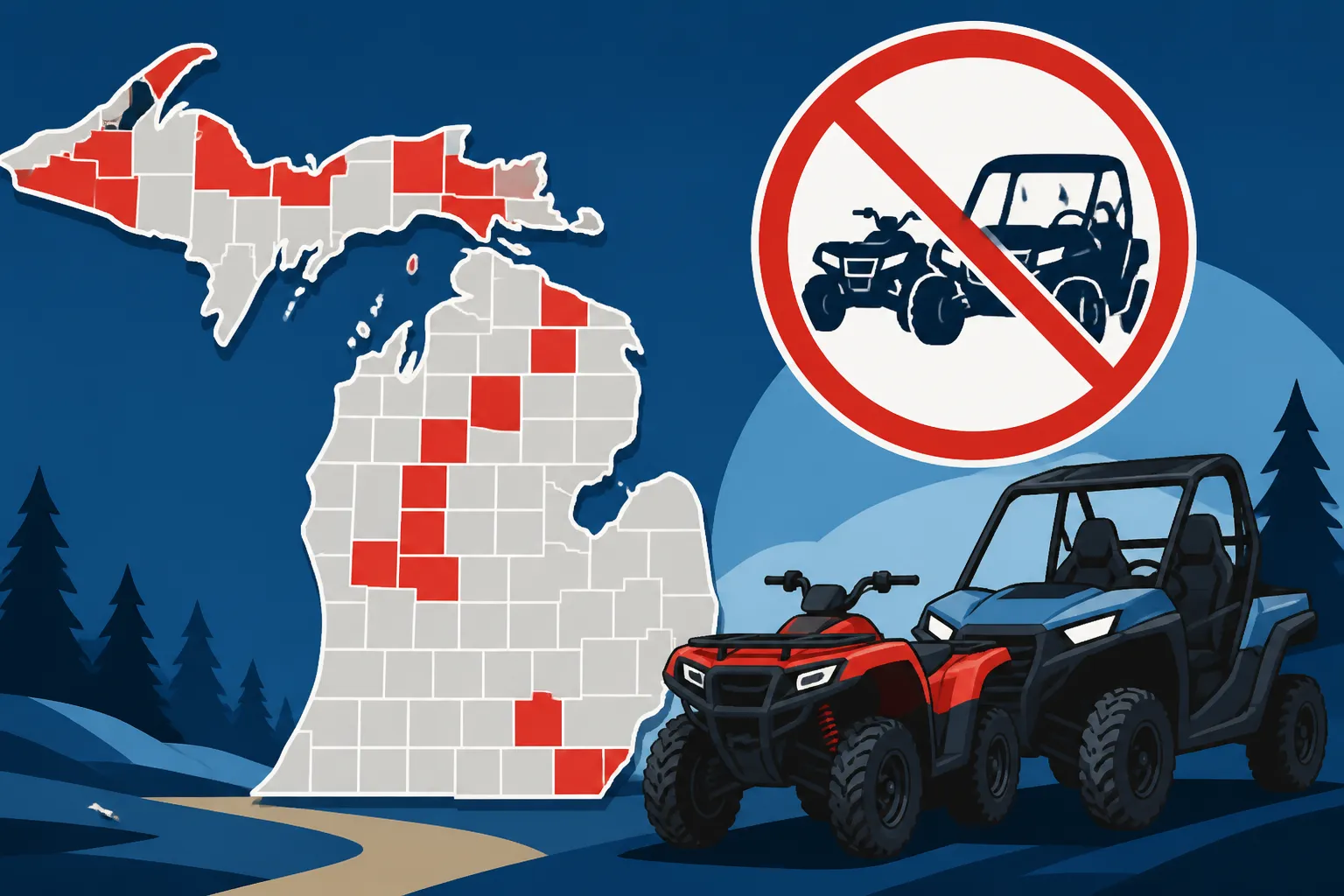
Michigan Counties Without an ORV Ordinance
One of the biggest headaches for off-road vehicle enthusiasts in Michigan is trying to figure out where, exactly, you can legally ride your ATV or UTV on the pavement. The Michigan ORV road law is a patchwork, leaving many riders scratching their heads about local rules. This guide is here to untangle the confusion surrounding Michigan counties that haven't adopted their own specific ORV ordinances, explaining what that means for you and how to navigate these often-unclear situations.
Understanding Michigan's ORV Road Law Framework
Michigan's approach to allowing Off-Road Vehicles (ORVs) on public roads is unique and, frankly, can be a bit of a maze. Unlike some states where a blanket state law covers everything, Michigan put the power largely in the hands of local governments, specifically the counties. This means that while there's a state law that permits ORVs on certain public roads, it's not a green light everywhere. Each county has the option to pass its own ordinance to open up or further restrict county roads to ORV use. It's like having a statewide buffet, but each restaurant (county) gets to decide what dishes they actually serve.
The state law, Public Act 288 of 2008, laid the groundwork. It essentially says that ORVs can be operated on the far right of the maintained portion of a county road, provided the county board of commissioners passes an ordinance to allow it. This legislation also outlines the basic safety requirements, like speed limits, driving on the far right, and crossing rules. However, it's crucial to understand that this is an enabling law, not an automatic one. If a county doesn't pass an ordinance allowing ORVs on its roads, then the default position is that ORVs are generally not permitted on those county roads, outside of specific situations like crossing a road or traveling for farming purposes under certain exemptions.
This creates a significant challenge for riders. You can't just assume that because you're in Michigan, you can ride on any county road. You have to know the specific rules for the county you're in. This legislative framework was designed to give local communities control over their roads, acknowledging that what works in the dense population centers of Southeast Michigan might not make sense in the vast, sparsely populated areas of the Upper Peninsula, or vice versa. The intent was good—local control—but the execution has led to a lot of frustration and uncertainty for riders who just want to enjoy their machines responsibly.
The Nuance of "Maintained Portion of the Road"
When the law talks about the "maintained portion of the road," it's not always as clear as it sounds. In many rural areas, county roads might have a gravel surface, and the "maintained portion" could encompass the entire drivable width. On paved roads, it refers to the paved surface, excluding the shoulder in most cases unless otherwise specified. Understanding [Michigan's Maintained Portion of the Road, Defined] is vital, because straying off this designated area could lead to a ticket, even if you are otherwise in compliance with a county ordinance.
This particular detail often catches riders off guard. They might think "far right" means the gravel shoulder, but the statute is quite specific. This is where good judgment and local knowledge become invaluable. Always err on the side of caution. If in doubt, assume the narrowest interpretation of "maintained portion" and stick to it. Many riders invest in robust mirrors and clear turn signals, readily available from companies like SuperATV, to ensure they are highly visible when operating on any road surface, regardless of local ordinances, just to be safe.
State Highways and Forbidden Zones
Beyond county roads, it's important to remember that state highways (those designated by M, US, or I prefixes) are almost universally off-limits to ORVs. You generally cannot ride on state highways except to cross them at a right angle or to use a short segment if specifically designated as part of an ORV trail. This is a statewide rule that doesn't change from county to county. Similarly, bridges, causeways, and often, specific municipal limits within counties, even those with ORV ordinances, have their own restrictions. The rules for [Michigan ORV Rules on Bridges and Causeways] and [Michigan ORV Rules Inside City Limits] are separate considerations that every rider needs to be aware of, regardless of the county's stance on its local roads.
This statewide prohibition on state highways is often where the line is drawn quite clearly. While county roads offer a gray area depending on local ordinances, state routes are almost always a hard no. It's a critical distinction to remember when planning your rides. Even if a county is ORV-friendly, it doesn't mean you can use your UTV to pop over to the next town via a major US route.
The Reality of Counties Without a Local Ordinance
So, what happens when a Michigan county hasn't passed an ORV ordinance? This is where many riders face frustration and uncertainty. The simple, often disappointing, answer is: if there's no ordinance explicitly allowing ORVs on county roads, then riding your ORV on those county roads is generally prohibited. It's not an oversight or a default "yes"; it's a default "no." The absence of an ordinance means the enabling state law isn't triggered, and ORV use remains restricted to private land or designated trails.
This can feel incredibly unfair, especially if you're traveling through an unfamiliar area or if neighboring counties have opened their roads. You might see a beautiful stretch of gravel road that looks perfect for a scenic ride, only to realize it's technically illegal because the county board hasn't acted. This scenario is particularly common in counties with lower ORV rider populations, or where local government might not see it as a priority, or perhaps there's significant local opposition to ORV road use.
Without a local ordinance, your ORV is restricted to:
- Designated ORV trails and routes.
- Private property (with permission, of course).
- Crossing a road at a right angle if done safely and legally.
- Certain agricultural or utility exemptions, which are very specific and don't apply to recreational riding.
You simply cannot treat those county roads as extensions of the trail system. Ignoring this can lead to tickets, fines, and even the impoundment of your machine. The penalty for [Penalty for Operating an Untitled ORV in Michigan] or operating in prohibited areas can be stiff, and it's simply not worth the risk. Many riders mistakenly assume that "no specific ban" means "it's allowed," but in Michigan's ORV road law, the opposite is true for county roads.
Why Some Counties Might Not Have an Ordinance
There are several reasons why a county might not have an ORV ordinance in place. It's rarely a sign of animosity towards riders, but rather a reflection of local priorities, demographics, and sometimes, a lack of understanding or initiative.
- Low Rider Population: In counties where ORV use isn't a dominant recreational activity, there might not be enough public demand or political pressure to prompt the county board to act.
- Resource Constraints: Passing and enforcing an ordinance requires time, research, and communication between various departments (sheriff, road commission, county clerk). Smaller counties might lack the resources or personnel to prioritize this.
- Local Opposition: Some communities may have concerns about noise, dust, safety, or environmental impact, leading to resistance against opening roads to ORVs.
- Lack of Awareness: Believe it or not, some county commissioners might simply not be fully aware of the state law, the process, or the local interest in opening roads to ORVs.
- Focus on Dedicated Trails: Some counties might prefer to funnel ORV activity to dedicated trail systems, believing it's safer and more controlled than mixing ORVs with regular traffic on county roads.
It's a complex issue with many facets, and it means that simply looking at a map won't tell you the full story. You really have to dig into the local regulations.
The "No ORV Ordinance" Table
Here's a simplified way to think about how ORV road rules typically break down in Michigan, contrasting counties with an ordinance versus those without one. This isn't a definitive list of counties, as those change, but rather a guide to the principles.
| Feature | Counties With an ORV Ordinance | Counties Without an ORV Ordinance |
|---|---|---|
| County Roads | Generally allowed on far right of maintained portion, 25 mph limit, specific safety rules. | Generally not allowed for recreational use. |
| State Highways | Generally prohibited (except for crossings or designated segments). | Generally prohibited (except for crossings or designated segments). |
| City/Village Streets | May have additional restrictions or prohibitions, even if the county has an ordinance. | Generally prohibited unless specifically allowed by municipal ordinance (rare for ORVs). |
| Trail Access | Direct access from county roads to trails often permitted. | Access to trails usually requires trailering to a trailhead or private land. |
| Safety Equipment | Helmet (if applicable), eye protection, lights, mirrors, spark arrestor, etc. | Same as above, required on trails or private land. |
| Permits & Titles | State ORV License, Trail Permit, Title required. | State ORV License, Trail Permit, Title required. |
This table highlights the stark difference that a local ordinance makes for recreational road riding. [Michigan's 25 mph Limit on County Roads] is a common rule when roads are open, but it's only applicable where permitted.
How to Research ORV Ordinances for Your Riding Area
Given the varied landscape of Michigan's ORV road laws, proactively researching the rules for your desired riding area is absolutely essential. You cannot rely on assumptions or what you've heard from a friend. A little detective work upfront can save you a lot of hassle, fines, and potential legal trouble later on. This is where you become your own best advocate for legal riding.
The best place to start is always at the county level. The information might not be immediately obvious on a basic Google search, but a few targeted approaches usually yield results.
1. Contact the County Clerk's Office
The county clerk's office is the official custodian of all county ordinances. This is perhaps the most reliable source of information. You can usually find their contact information (phone number and email) on the county's official website. When you call or email, clearly state that you are inquiring about "ORV ordinances related to the operation of Off-Road Vehicles on county roads." Be prepared with specific questions, such as:
- "Has [County Name] County passed an ordinance under Michigan Public Act 288 of 2008 to allow ORV operation on county roads?"
- "If an ordinance exists, where can I find a copy of it?"
- "Are there any specific roads or areas within the county that are excluded or have different rules?"
They might direct you to an online portal where ordinances are published or offer to email you a copy. This direct approach often provides the most accurate and up-to-date information.
2. Check the County's Official Website
Many Michigan counties maintain official websites where they publish board meeting minutes, resolutions, and, crucially, their local ordinances. Look for sections titled "Ordinances," "County Clerk," "Board of Commissioners," or "Legal." You might need to use the website's search function for "ORV," "off-road vehicle," or "Public Act 288."
Keep in mind that website navigation can vary greatly, and sometimes the information is buried deep. Don't give up if you don't find it on the first click. Some counties might have a dedicated page for "Road Commission" or "Sheriff's Department" that could also contain this information or links to it. You can learn [How to Find Your Michigan County's ORV Ordinance] by following these steps.
3. Reach Out to Local Law Enforcement (Non-Emergency)
Your local sheriff's department or Michigan State Police post can also be a valuable resource. Call their non-emergency number and ask to speak with an officer regarding ORV road laws in the county. They are the ones who enforce these laws, so they should be well-versed in what's permitted and what's not. However, always confirm what they tell you with an official source (like the county clerk's office) if possible, as interpretations can sometimes vary, and you want to be certain for your own protection.
4. Consult Local ORV Clubs and Forums
While not official sources, local ORV clubs and online forums for Michigan riders can be excellent resources for practical, real-world advice. Members often share their experiences, including where they've successfully ridden and where they've encountered issues. They might even have direct knowledge of specific ordinances or the challenges in getting one passed. Websites like Michigan ORV Association or local Facebook groups dedicated to Michigan ATV/UTV riding can be goldmines of shared information. However, always cross-reference this anecdotal information with official sources.
5. Check Michigan DNR Resources
The Michigan Department of Natural Resources (DNR) maintains vast resources for ORV riding, including trail maps and permit information. While they don't typically host every single county ordinance, their trail maps often indicate areas where ORV road use connects to the trail system, implying an ordinance might be in place for those specific roads. This can be a good starting point to identify areas where riding might be more permissive. You can download [Downloading Michigan DNR ORV Trail Maps] to see designated routes.
By combining these research methods, you should be able to get a clear picture of the ORV road rules in any Michigan county you plan to visit. It's a bit of work, but it's far better than facing a hefty ticket.
Riding Smart and Legally in "Undefined" Territory
Navigating counties without explicit ORV ordinances means taking a cautious and responsible approach to your riding. Since the default is generally prohibition on county roads, your primary focus should be on staying within clearly legal areas, primarily designated trails and private land. However, there are also best practices for being a responsible rider, even when local rules are vague or non-existent for road use.
Stick to Designated Trails and Private Land
In counties without an ORV ordinance, your safest and most legal bet is to ride exclusively on designated ORV trails or on private property with the landowner's express permission. Michigan boasts thousands of miles of incredible trails, so there's usually no shortage of places to ride legally. Always ensure you have your [Michigan ORV License and Trail Permit Explained] current and visible on your machine, and carry your title or a copy, just in case. Understanding [Michigan's 4,000 Miles of ORV Trails Explained] is key to finding legal places to ride.
If you're using private land, make absolutely sure you have permission. Trespassing is a serious issue, and it can quickly sour relations between landowners and the ORV community. Always confirm boundaries and respect the property you're on.
Be Prepared for Road Crossings
Even in counties without ORV road ordinances, you'll inevitably encounter situations where you need to cross a county road to get from one section of a trail to another, or to access a staging area. Michigan law generally permits ORVs to cross a road at a right angle, after coming to a complete stop and yielding to all traffic.
When making a road crossing:
- Stop Completely: Treat it like a stop sign at an intersection.
- Look Both Ways: Thoroughly check for traffic in both directions.
- Yield to All Traffic: Do not proceed until the road is clear.
- Cross at a Right Angle: Go straight across, not at an angle that implies you're trying to ride down the road.
- Minimize Time on the Road: Get across as quickly and safely as possible.
These brief road contacts are distinct from riding on the road. Always ensure your machine is equipped with the necessary safety gear, like headlights, taillights, and reflectors, which are vital for visibility, especially during these crossings.
Equipping Your Machine for Maximum Safety and Visibility
While an ordinance might not exist, being a responsible rider means being as safe and visible as possible, especially if you anticipate any brief road use for crossing or specific exemptions. Many riders opt for street-legal modifications even if their county doesn't technically allow ORVs on roads, simply for peace of mind and enhanced safety. Companies like SuperATV offer a wide range of accessories that can improve your machine's road-readiness.
Consider adding:
- Turn Signals: Even if not required for an ORV, clear turn signals enhance communication with other drivers during crossings or in situations where you might briefly share a paved surface.
- Side and Rearview Mirrors: Crucial for seeing traffic behind and beside you.
- DOT-Approved Tires: While not necessary for trail riding, they offer better grip and durability on pavement during crossings.
- Horn: A loud audible warning device is a fundamental safety feature for any vehicle.
- Brighter Lighting: Upgraded headlights and taillights improve your visibility to others.
Having these safety features not only helps prevent accidents but also demonstrates to law enforcement that you are a responsible operator, even if you find yourself in a gray area. This proactive approach to safety is always a good idea, regardless of local statutes.
Advocating for Change (Respectfully)
If you live in a county without an ORV ordinance and believe one should be put in place, you can advocate for change. This isn't about breaking the rules, but about working within the system.
- Educate Yourself: Understand the state law and the process for local ordinances.
- Contact Your County Commissioners: Politely express your interest, explain the benefits (e.g., tourism, local access to trails), and ask about the possibility of an ordinance.
- Form or Join a Local ORV Group: There's strength in numbers. A unified voice is more impactful than individual complaints.
- Attend County Board Meetings: Show up and express your views during public comment periods.
- Be a Responsible Rider: The best way to advocate for ORV access is to demonstrate that riders are responsible, respectful, and safe. Adhering to all other ORV laws (like having a valid permit and operating safely) helps build a positive image.
Remember, patience and persistence are key. Local legislative processes can be slow, but responsible advocacy can eventually lead to positive change for the ORV community in your area.
Disclaimer
This article is for general informational purposes only and does not constitute professional advice. Laws, prices and regulations vary by location and change over time. Consult a qualified professional for guidance on your specific situation.