Dealer Paperwork Checklist for a New UTV
Buying a brand-new UTV from a Michigan dealership should be an exciting experience, but the stack of paperwork they hand you can quickly turn that excitement into a headache. Many folks feel rushed through the signing process, wondering if they've missed something crucial or if all those signatures were truly necessary. This guide is here to walk you through every piece of documentation you're likely to encounter when purchasing a new side-by-side, helping you understand what each one means for you as a Michigan ORV owner.
The Initial Purchase Agreement and Why It Matters So Much
When you decide on that perfect new UTV, the first major hurdle is usually the purchase agreement. This isn't just a receipt; it's a legally binding contract that outlines the entire transaction. It's the blueprint for your purchase, detailing everything from the vehicle's specifics to the final price and payment terms. Skimming this document can lead to misunderstandings or hidden costs down the road, so it’s crucial to give it your full attention. Many buyers feel pressured to sign quickly, especially if they're eager to get out on the trails, but taking your time here can save a lot of grief later.
Understanding Your Sales Contract Details
Your sales contract will typically start with identifying information for both you, the buyer, and the dealership. It will clearly list the UTV you're purchasing, usually including its Vehicle Identification Number (VIN), make, model, and year. This is your first critical check: does the VIN on the contract match the VIN on the machine you're buying? Discrepancies here can cause massive headaches when you go to title the vehicle. You'll also see the agreed-upon purchase price, which should break down the base price, any added accessories, freight charges, and other fees. Make sure every charge is something you discussed and agreed to. This document is the definitive record of what you're buying and for how much.
Beyond the numbers, the sales contract will also detail any trade-in allowances if you're swapping an old machine for a new one. It will specify any rebates or special promotions being applied, and it might even outline the expected delivery date if the UTV isn't immediately available. Think of this as the master document that everything else flows from. If you ever have a dispute with the dealership, this is the paper you'll refer back to. Ensuring its accuracy from the start is paramount. A good resource for understanding what robust sales documents look like, even if for private sales, can be found through platforms like LawDepot, which provides templates that highlight key clauses and necessary details.
Deposits, Financing, and Contingencies
Most new UTV purchases involve a deposit to hold the machine and finalize the deal. The sales contract will clearly state the amount of this deposit, whether it's refundable, and under what conditions. It's vital to understand these terms, especially if you're waiting on financing or need to sell another item first. If your purchase is contingent on securing a loan, this should also be explicitly mentioned in the contract. For example, if your financing falls through, is your deposit fully refundable, or do you forfeit a portion?
Similarly, if you're taking out a loan, the contract will reference the financing agreement, which is a separate but related document we'll discuss later. Sometimes, there are contingencies related to pre-delivery inspections or specific accessory installations. Always read the fine print regarding what happens if these conditions aren't met. It protects both you and the dealer, ensuring everyone is on the same page regarding the sale's progression and any potential roadblocks.
Title and Registration Documents from the Dealer
Once the sales agreement is in place, the dealer's role in getting your UTV officially recognized in Michigan begins. This involves handling the initial titling paperwork that you'll eventually submit to the Secretary of State (SOS). It’s easy to think the dealer handles everything, but you'll still have a part to play, especially when it comes to understanding what they've prepared for you. Missing or incorrect information on these forms can lead to significant delays in getting your new machine out on the trails legally.
The Manufacturer's Certificate of Origin (MCO)
The Manufacturer's Certificate of Origin, often called an MCO or MSO (Manufacturer's Statement of Origin), is perhaps the most critical document for a brand-new UTV. This is essentially the birth certificate for your machine. It proves that the vehicle is new, hasn't been titled before, and details all its original specifications directly from the factory. The MCO includes the UTV's VIN, make, model, year, and usually engine size. Without a valid MCO, you cannot title your new UTV in Michigan. The dealer will typically sign over the MCO to you as part of the sale.
You should always receive the original MCO from the dealer. They should never keep it or send it directly to the Secretary of State without your involvement. You'll need this original document to apply for your initial Michigan ORV title. Make sure the MCO is filled out correctly by the dealer, with your name as the purchaser and the date of sale accurately noted. It's the primary proof of ownership when a vehicle is brand new, so treat it like gold. Losing it means a significant headache trying to get a duplicate. For more on this process, check out [Michigan ORV Title Application and What It Costs].
Dealer-Prepared Michigan Title Application
Many dealerships in Michigan will prepare the initial Michigan ORV title application form (Form TR-11L, or similar) on your behalf. While they fill it out, you are responsible for verifying its accuracy before you sign it. This form is what you will submit to the Michigan Secretary of State to get your permanent title. It will include your personal information, the UTV's details from the MCO, and typically the sales tax calculation. Don't be shy about asking the finance manager or salesperson to walk you through each section.
Crucially, ensure your full legal name and address are correct, as this is what will appear on your official title. Verify the VIN and other vehicle information matches both the MCO and your sales contract. Any errors here can result in your application being rejected by the SOS, meaning another trip and more waiting. While the dealer is doing you a service by preparing it, the ultimate responsibility for its correctness rests with you, the owner. You'll also need to know [Michigan Gives You 15 Days to Title an ORV], so getting this application correct the first time is a time-saver.
Sales Tax Collection and Reporting
Michigan requires sales tax to be paid on the purchase of all ORVs, whether new or used. When you buy from a licensed dealer, they are obligated to collect this sales tax directly from you at the time of purchase. The sales tax amount should be clearly itemized on your sales contract and on the title application form. The dealer then remits this tax to the State of Michigan on your behalf. This is a significant advantage of buying from a dealer versus a private seller, where you would typically have to pay the sales tax directly to the Secretary of State when you title the vehicle.
Keep a copy of your sales contract showing the sales tax paid. This serves as your proof that you've fulfilled your tax obligation. If for any reason the dealer did not collect sales tax (which is highly unusual for a new UTV), be aware that you will be responsible for paying it to the Secretary of State when you apply for your title. Understanding [Michigan ORV Sales Tax at a Secretary of State Branch] can clarify what happens if you buy from a private party, giving you a point of comparison for the dealer experience.
Understanding Optional Add-ons and Warranties
Beyond the core purchase of the UTV, dealerships often offer a range of optional add-ons, accessories, and warranty packages. These can significantly enhance your riding experience or provide peace of mind, but they also add to the overall cost. It's essential to scrutinize these offerings and understand exactly what you're getting and what you're paying for, as they will come with their own set of documentation. Don't feel pressured into accepting anything you don't fully understand or truly need.
Extended Warranties and Service Contracts
A new UTV typically comes with a manufacturer's limited warranty, covering defects for a specific period or mileage. Dealers will often present options for extended warranties or service contracts that go beyond this initial coverage. These can be appealing, promising protection against unexpected repair costs after the factory warranty expires. The paperwork for these will detail the coverage terms: what components are covered (engine, transmission, electrical, etc.), the duration of the coverage (e.g., 3 years/3,000 miles), any deductibles per claim, and exclusions (e.g., normal wear and tear, abuse, modifications).
Carefully read the fine print of any extended warranty or service contract. Understand the claims process, whether you can take the UTV to any authorized service center, and if the coverage is transferable if you sell the UTV later. Some contracts might require specific maintenance schedules to keep the warranty valid. While they can offer peace of mind, ensure the cost justifies the coverage provided, especially for a machine that might see seasonal use. It's an investment, so make sure it's one that makes sense for your riding habits and budget.
Accessories, Customizations, and Installation Agreements
Many UTV owners love to personalize their machines with accessories like winches, light bars, upgraded tires, or custom graphics. Dealerships are often happy to sell and install these items for you, and this will generate additional paperwork. This documentation should clearly list each accessory, its price, and any labor charges for installation. If the dealer is installing these items, ensure there's an agreement on the timeline for completion and what happens if there are delays or issues with the installation.
It's also a good idea to confirm if the installation of aftermarket accessories by the dealer affects your manufacturer's warranty. While reputable dealers typically install approved accessories, it's wise to have this clarified in writing if possible. Sometimes, modifications can void certain parts of the original warranty, even if installed professionally. Make sure your agreement includes a clear list of all items installed, their costs, and any specific guarantees on the installation itself. This prevents confusion later if an accessory malfunctions or is not installed to your satisfaction. You want to hit the trails confident in your machine's setup, and clear documentation helps achieve that.
Essential Paperwork for Financing Your New UTV
For most people, buying a new UTV involves some form of financing. Whether you're getting a loan through the dealership's finance department or bringing your own pre-approved loan, there will be a significant amount of paperwork associated with securing that funding. This paperwork is crucial because it outlines your financial obligations, the terms of your loan, and how the lender's interest in your UTV is protected. Navigating this successfully ensures you own your UTV free and clear after making all your payments.
Loan Agreements and Disclosure Statements
If you finance your UTV through the dealership, you'll be signing a comprehensive loan agreement. This document details the principal amount borrowed, the interest rate, the loan term (number of months), and your regular payment amount. It also includes an amortization schedule, showing how much of each payment goes toward principal versus interest over the life of the loan. The Annual Percentage Rate (APR), which reflects the true cost of borrowing, will be prominently displayed. Additionally, you'll receive various disclosure statements required by law, such as the Truth in Lending Act disclosure, which provides a standardized summary of the loan terms.
Carefully review every line of your loan agreement. Ensure the interest rate, term, and payment amount match what you were quoted and agreed upon. Look for any prepayment penalties, which are rare on consumer loans these days but still worth checking. Understand what constitutes a default on the loan and the consequences. This is a long-term commitment, so confirming all the details before you sign is absolutely critical. You might even find templates on platforms like LawDepot that help you understand the common clauses in such agreements, which can be useful even when dealing with a dealership's own forms. Knowing what to expect makes the process smoother.
Understanding Liens on Your Title
When you finance a UTV, the lender typically places a lien on the vehicle's title. This means that until the loan is fully paid off, the lender has a legal claim to the UTV. The Michigan Secretary of State records this lien when the title is issued. The loan agreement paperwork will specify that a lien will be placed on your title and that the lender will hold the physical title (or electronically record their lien) until the debt is satisfied. This protects the lender's investment.
You won't receive the actual title document until you've made your final payment. Once the loan is paid off, the lender will send you a lien release, which is a document stating that their claim on your UTV is satisfied. You will then take this lien release to the Michigan Secretary of State to get a clear title issued in your name. Understanding [Liens on a Michigan ORV Title] is key to knowing this process and what happens once you've successfully paid off your machine. Always keep copies of your loan agreement and all payment records until that lien is officially released and you have your clear title in hand.
Post-Sale Documentation: What to Keep and Why
Once all the papers are signed, the keys are in your hand, and the UTV is yours, your responsibility isn't over. There are crucial documents you need to keep safe and accessible for various reasons, from proving ownership to handling potential roadside stops by law enforcement. Think of these papers as your UTV's life story, detailing its origins, ownership, and legal status. Having them organized and secure can save you significant hassle and stress down the line.
Your Copy of the Signed Documents
After the signing spree, the dealership will provide you with copies of every document you've signed. This typically includes the sales contract, the MCO (Manufacturer's Certificate of Origin), the title application form, any extended warranty agreements, and all financing paperwork. It is absolutely essential that you keep these copies in a safe, organized place. These are your official records of the transaction and your proof of ownership, purchase price, and financial obligations.
Consider creating a dedicated folder, either physical or digital, for your UTV's documents. You'll need these if you ever need to reference warranty terms, dispute a charge, or calculate depreciation for tax purposes. If you plan to sell the UTV privately down the road, having all the original purchase documents can add credibility to your listing and help with the sale process. Losing these can be a real headache, especially if you ever need to prove the sales tax was paid or if questions arise about the UTV's history. For private sales, having a template like those offered by LawDepot can assist in creating a clear [Michigan ATV Bill of Sale: What to Put in It].
Temporary Operating Permits and Dealer Plates
While you wait for your official Michigan ORV title and registration to arrive from the Secretary of State, the dealer will often provide you with a temporary operating permit or temporary dealer plate. This allows you to legally operate your new UTV during the interim period. These temporary permits usually have an expiration date (often 30 days) and must be clearly displayed on your UTV. Make sure you understand the limitations of this temporary permit, such as where and when you can legally ride.
Keep the temporary permit with your UTV whenever you ride, along with your proof of insurance. This is what you'll show a Michigan Department of Natural Resources (DNR) officer or local law enforcement if you're stopped. Relying on just your word that "the title is in the mail" won't cut it. Once your official title and any ORV license/trail permits arrive, you'll replace the temporary permit with your permanent documentation. Understanding [Michigan ORV Paperwork During a DNR Stop] will highlight why having these documents readily available is important.
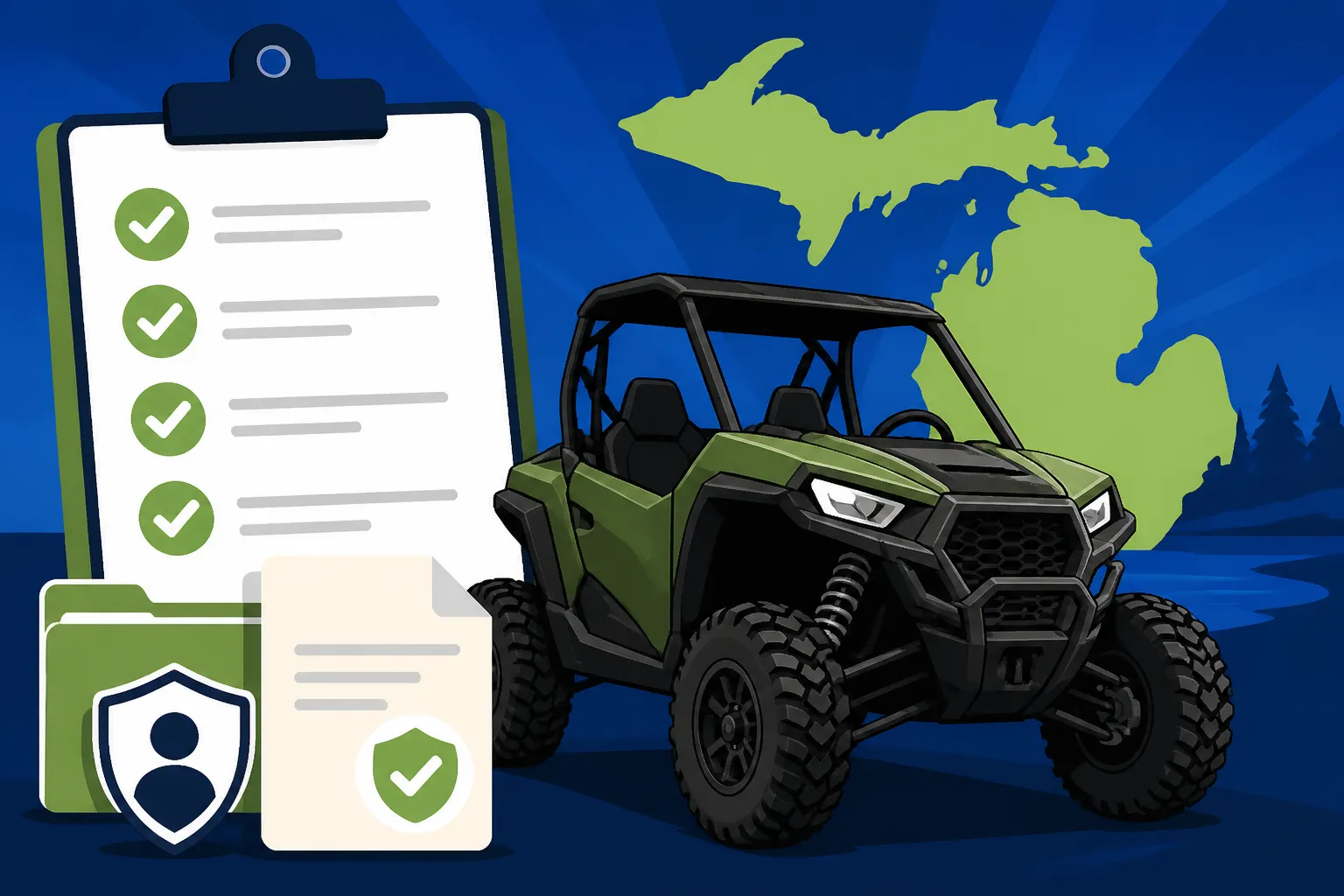
Michigan ORV Dealer Paperwork Checklist
To help you keep track of all the important documents you should expect when buying a new UTV from a Michigan dealer, here's a handy checklist. Use this as a guide to ensure you're getting everything you need before you leave the dealership.
| Document Type | Purpose | Your Responsibility |
|---|---|---|
| Sales Contract/Buyer's Order | Legal agreement for purchase; outlines price, UTV details, and terms. | Review thoroughly, confirm all details, understand pricing and contingencies. |
| Manufacturer's Certificate of Origin (MCO) | "Birth certificate" of the UTV; essential for initial titling. | Ensure you receive the ORIGINAL MCO, verify VIN and details, keep safe. |
| Michigan Title Application (TR-11L) | Form filled out by dealer to apply for your title. | Verify all personal and UTV information is accurate before signing. |
| Proof of Sales Tax Paid | Itemized sales tax on contract or separate receipt. | Confirm sales tax collected by dealer; keep proof for your records. |
| Loan Agreement/Promissory Note | Details your financing terms, interest rate, payments. | Read carefully, understand all terms, interest, and payment schedule. |
| Security Agreement | Grants lender a lien on the UTV until loan is paid. | Understand the lien process and how to get a clear title later. |
| Extended Warranty/Service Contract | Optional coverage beyond factory warranty. | Review coverage, deductibles, exclusions, and claims process. |
| Accessory Installation Agreement | Details added accessories, costs, and installation schedule. | Verify all items and costs, confirm installation timeline, and warranty implications. |
| Temporary Operating Permit/Plate | Allows legal operation while waiting for permanent title/registration. | Display clearly, understand expiration date, carry with you when riding. |
| New Owner's Packet/Manuals | UTV owner's manual, warranty book, service schedules. | Read manuals for operation, maintenance, and safety; keep warranty information handy. |
Disclaimer
This article is for general informational purposes only and does not constitute professional advice. Laws, prices and regulations vary by location and change over time. Consult a qualified professional for guidance on your specific situation.