Overnight Trailer Parking at Trailheads
Finding a place to leave an ATV trailer overnight in Michigan can be harder than finding the trail itself. A lot that looks empty at dusk may have posted hours, seasonal restrictions, or no overnight parking permission at all. This guide explains how to check before you go, choose a safer setup, and avoid returning to a ticket, tow, or missing gear.
Confirm overnight parking is allowed before you unload
Treat a trailhead lot as day-use parking unless signs say otherwise
A trailhead parking area is not automatically an overnight campground or long-term trailer lot. Some lots are intended for people who park while riding and leave the same day; others may allow overnight parking under certain conditions. Rules can differ by land manager, location, season, and even between nearby access points, so there is no single Michigan-wide assumption that makes an overnight stay permissible.
Look for posted hours, “no overnight parking” notices, vehicle or trailer restrictions, and instructions about where to park. Check signs at the entrance as well as signs inside the lot. If there is no clear information, do not treat silence as permission. Contact the land manager, local trail office, campground, or other responsible authority before leaving a trailer overnight. Ask specifically about your planned dates, trailer size, and whether an ATV or UTV may remain attached.
This extra check matters on a busy weekend. Imagine reaching a trailhead near St. Helen late in the day, finding a vacant corner, and deciding to leave your trailer there while you ride the next morning. If the area closes overnight or the lot is reserved for a particular use, the empty space does not necessarily make parking legal. A quick confirmation before departure can save a long drive back to retrieve equipment.
Identify who manages the access point
Michigan riding areas can involve different land managers and parking arrangements. A trailhead may be associated with state forest land, a local government, a private business, a campground, or a trail organization. The nearest town is not always the authority that sets parking rules, and a rule at one entrance may not apply to another lot along the same route.
Start by identifying the exact access point, not just the trail system. Use the official trail map or land manager’s information to narrow down the location, then call or message the office responsible for that property. If the trailhead is beside a campground or business, ask whether its parking area is available to trail users overnight and whether a separate fee, reservation, or check-in is required. Do not assume that a nearby business lot is open to the public after hours.
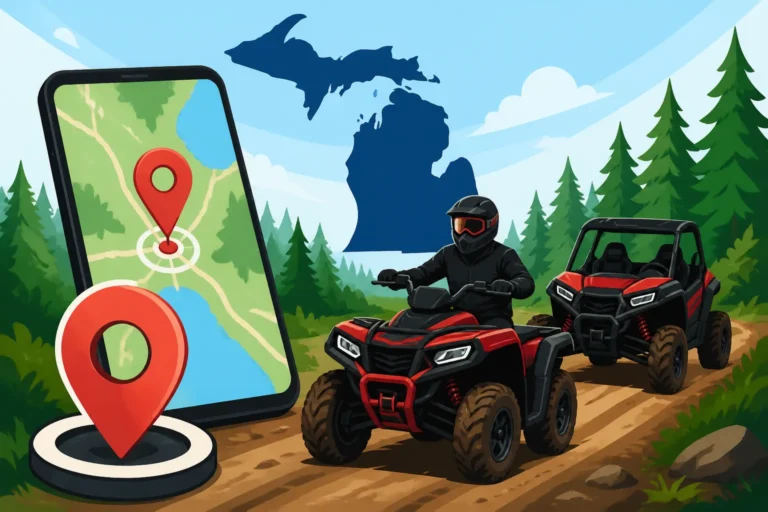
Digital maps can help you orient yourself and compare nearby access points. onX Offroad may be useful for previewing roads, trail connections, and possible staging areas, but a map app is not proof that overnight parking is allowed. Confirm the rules with the property manager or posted notices. For more on using map information, see Michigan ORV Trail Maps and What the Signs Mean and Downloading Michigan DNR ORV Trail Maps.
Ask precise questions, not just “Can I park here?”
When you contact a land manager, explain what you are bringing and what you plan to do. A pickup with a short utility trailer takes up less room than a long enclosed trailer, and an attached trailer may be treated differently from a trailer left unattended. Ask whether you can park overnight, whether the trailer must remain hitched, where it should be placed, and whether there are arrival or departure hours.
It also helps to ask what happens if the lot fills up, whether parking is permitted on adjacent roads, and whether the area has seasonal closures or event restrictions. If staff give you permission, note the name or office you spoke with and the date of the conversation. That record does not override a posted rule, but it can help you remember the instructions and clarify a misunderstanding.
| What to confirm | Why it matters |
|---|---|
| Overnight parking permission | A lot may be intended for daytime trail use only |
| Trailer size and configuration | Long or wide rigs may not fit in designated spaces |
| Parking location | A particular row or area may be reserved or restricted |
| Check-in or departure times | Access may be limited outside posted hours |
| Seasonal or event restrictions | A normally available lot may close or fill during busy periods |
| Backup option | You need a legal alternative if the trailhead lot is full |
Choose a parking setup that fits your trailer and ride plan
Check the approach as carefully as the parking space
A trailhead may have enough room to park but a difficult approach for a long trailer. Before committing, look at the access road, turning area, surface, slope, and clearance. A narrow entrance or tight turnaround can become stressful when another truck is behind you or the lot is crowded. If you are towing an enclosed trailer, consider whether branches, soft shoulders, or uneven gravel could make entry or exit difficult.
Do not rely only on a satellite view to judge a route. Conditions can change, and an image may not show current construction, washouts, gates, snow, mud, or posted restrictions. Use a map to plan, then check current official information and signs on arrival. If the access road looks unsuitable, avoid forcing the trailer through simply because the trailhead is close.
Think through the whole maneuver before you arrive: where you can turn around, how you will leave if the lot is busy, and whether you can park without blocking other vehicles. Leave enough room for other riders to open doors, unload machines, and maneuver their own trailers. A convenient spot that blocks the entrance or occupies multiple spaces can create problems for everyone.
Match the parking choice to the kind of visit
For a short ride, a day-use trailhead lot may be all you need, provided its rules allow your vehicle and trailer to stay for the duration of the ride. For an overnight trip, a campground or private facility that explicitly permits trailer parking may be a more predictable choice. Campgrounds near riding areas can also offer a place to sleep, access to facilities, and a clear person to contact about parking arrangements.
If you are riding in the Upper Peninsula, on Drummond Island, or near a popular destination such as Silver Lake, do not assume that an access point or nearby public lot has the same parking policy as a campground in the area. Confirm the exact location and the dates of your visit. For trip planning around specific riding areas, Michigan ORV Staging Areas and Parking and Camping Near Michigan ORV Trails can help you think through where to start and stay.
A second option is to arrange parking with lodging or a rental provider, if they permit it. Get clear permission rather than leaving the trailer in a hotel or business lot by assumption. Ask whether the trailer may remain overnight, whether it must be moved at a certain time, and whether the vehicle and trailer need to be registered with the property. Rules may be different for guests than for non-guests.
Build a backup plan before towing north
A backup plan matters because a full lot can leave you with few comfortable choices, especially after a long drive. Before leaving home, identify another legal parking option, such as a campground, a designated staging area, or a private location where you have confirmed permission. Make sure the alternate site is practical for your trailer and does not require you to travel on a route your rig cannot handle.
You can use onX Offroad to organize possible access points and keep a general sense of where they are, then verify each location through the responsible land manager. Save the address or coordinates of your confirmed backup and note any access instructions. If cell service is weak, downloaded maps or written directions can help you navigate without relying on a live connection.
For long trail days, consider whether the backup location affects your riding plan. A different starting point may mean more road travel, a different permit requirement, or a route that is unsuitable for your machine. Review Michigan ORV Trailhead Parking Rules and Michigan ORV License and Trail Permit Explained before you settle on an alternate. Parking permission and riding authorization are separate questions; having one does not automatically satisfy the other.
Reduce theft, damage, and avoidable parking problems
Secure the trailer and machines without blocking the lot
When overnight parking is expressly permitted, park where directed and keep the trailer within the space or area assigned. Do not leave a vehicle or trailer across an access lane, in front of a gate, or where it could prevent emergency or maintenance access. If the parking surface is uneven, choose a stable position and use the trailer’s normal parking and securing equipment.
Lock the trailer and machines, remove keys, and avoid leaving valuable riding gear visible. Keep ownership and contact information available in case a land manager needs to reach you. A hitch lock, wheel lock, or other suitable anti-theft device may discourage an easy grab, but no device makes an unattended setup theft-proof. If a lot is isolated or poorly lit, consider whether a staffed campground or other permitted location would give you greater peace of mind.
Before walking away, take a few photos of the trailer, tow vehicle, and surrounding area. This can help you remember how you parked and document the condition of your equipment. It is also useful to record the lot’s location and any nearby signs. If something looks questionable, move to a confirmed location rather than hoping the issue will not matter overnight.
Keep permits and trail rules separate from parking rules
A trailer parked at a trailhead does not grant permission to ride every nearby road or path. Check the rules for the route you plan to use, including machine-width restrictions, seasonal closures, and whether a license or trail permit is required. Michigan routes can differ in what types of ORVs they allow, so confirm that the planned route suits your ATV or UTV.
Keep your machine’s required permits in order and check placement requirements before departure. If you are new to the area, the sign at a trail junction may indicate a restriction that is easy to miss when you are focused on towing or unloading. Reviewing Michigan ORV Trail Widths Explained and Michigan ORV Trail Closures and Seasonal Dates can help you spot common trip-planning issues.
Also consider road access between the parking area and trail. A trailhead may be close to a town or road network, but that does not mean every connecting road is open to ORVs. Verify local access rules and use designated routes. If the lot is not directly connected to your intended route, plan how the machines will get there legally instead of improvising on arrival.
Have a simple arrival and departure routine
When you arrive, read the signs before unloading. Confirm that the lot matches the location you checked in advance, note any temporary notices, and make sure the trailer fits without obstructing other users. If the lot is unexpectedly crowded or a sign conflicts with what you were told, pause and contact the responsible authority rather than assuming the earlier information still applies.
Before leaving for the trail, check that lights, locks, and hitch connections are secure and that nothing is left in the travel lane. Let someone know where you parked and when you expect to return, especially if you are riding a remote route. If the ride takes longer than expected, contact the property manager when possible rather than ignoring a stated closing time.
At the end of the ride, do a quick walk-around before towing out. Check for damage, confirm that your gear is accounted for, and leave the space clean. If you notice a broken sign, damaged surface, or unsafe condition, report it to the property manager. Good trailhead etiquette helps keep access welcoming for the next rider and makes it easier for managers to continue accommodating trailers.
Avoid common overnight trailer parking mistakes
Do not assume an empty lot is an available lot
A vacant space can be reserved, temporarily closed, or unsuitable for overnight use. This is especially easy to misread when you arrive late or when signs are posted farther inside the property. Look for the rules at the entrance, and if they are unclear, ask before leaving the trailer.
Another common mistake is relying on what another rider did on a previous visit. Parking arrangements can change, and a neighbor’s experience may have involved permission you do not have. The same goes for social media posts or older map notes. Treat them as clues, not as authorization.
If you cannot confirm that overnight parking is allowed, choose a place that clearly permits it. That may mean driving farther or changing your ride plan, but it is usually better than risking a tow or returning to find that the lot has been closed.
Do not leave a trailer where it interferes with other users
Even where overnight parking is allowed, the location and layout matter. A trailer that blocks a gate, narrows an access road, or occupies several marked spaces can create a safety hazard and prompt complaints. Park only where the manager directs, and do not use an adjacent shoulder or roadside area as an overflow lot unless that use is explicitly permitted.
Be considerate of people arriving early, families unloading machines, and emergency or maintenance vehicles. If you are traveling with several rigs, make a plan to fit within the designated area rather than spreading across the lot. If the group will not fit, divide the vehicles among approved locations.
Do not confuse a trail map with current parking permission
Map apps are useful for navigation, but they do not replace a land manager’s current rules. onX Offroad can help you explore routes and keep track of a planned ride, yet the app should not be your only source for deciding whether a specific parking lot is open overnight. Use it alongside official maps, posted signs, and direct confirmation.
That distinction is particularly useful when planning a multi-day ride or traveling to an unfamiliar area. A map may show a road or staging point without explaining hours, reservations, or overnight restrictions. Check the details for each stop, and save the contact information for the relevant authority before you lose cell service.
A reliable plan is simple: confirm the exact lot, get permission for the specific dates and trailer setup, identify a backup, and follow posted instructions when you arrive. That small amount of preparation can make the parking part of a Michigan trail trip much less stressful.
Disclaimer
This article is for general informational purposes only and does not constitute professional advice. Laws, prices and regulations vary by location and change over time. Consult a qualified professional for guidance on your specific situation.